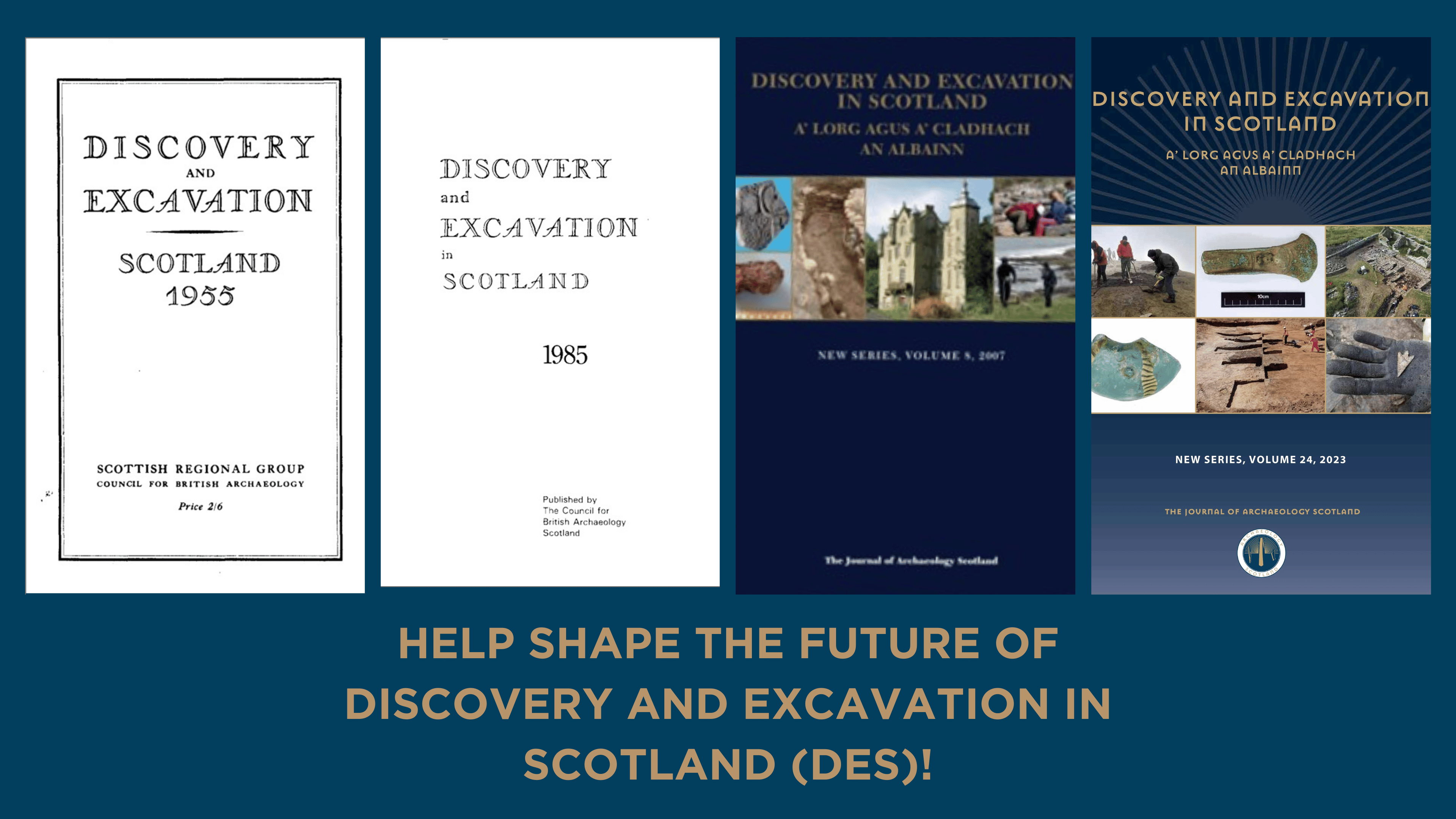
The first appearance of Discovery and Excavation in Scotland (DES) was a few paragraphs in the 1947 newsletter of the Scottish Regional Group of the Council for British Archaeology. In 2024, 77 years on, we want to celebrate the legacy of DES and ask for your feedback to ensure it continues to meet the needs of our sector and the public while becoming more sustainable for the future. Your thoughts are hugely appreciated and vital in helping DES continue to be a cornerstone publication on Scotland’s archaeology for years to come!
We want to hear from you:
- What do you like (or dislike) about the journal?
- How would you like to see it develop?
- Are there new formats or approaches we should explore?
Please give a few minutes to complete our survey and help guide the future of this essential resource, or scan the QR code below if you are on desktop and would rather fill in the form on your phone:
https://www.surveymonkey.com/r/ASJournalDES
Past Issue of DES, for your reference:
https://www.archaeologyscotland.org.uk/about-us/publications/discovery-and-excavation-in-scotland-des/

Read on to learn more about the history of DES written by Jennifer Thoms (DES Editor / Project Officer)
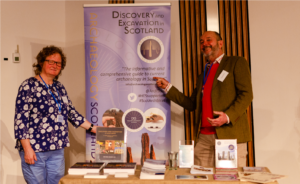
Archaeology Scotland staff, Jennifer Thoms and David Gilchrist, promoting DES at the Holyrood reception held to mark 75 years of Archaeology Scotland.
The first appearance of Discovery and Excavation in Scotland (DES) was a few paragraphs in the 1947 newsletter of the Scottish Regional Group (SRG) of the Council for British Archaeology. The report, ‘Discovery and Excavation in 1946’, summarised sixteen discoveries and excavations from Ayrshire, Caithness, Dumfriesshire, Edinburgh, Fife, Lanarkshire, Midlothian, Roxburghshire and West Lothian.
In 1955 it was decided by the SRG that the second part of their annual newsletter, containing the discoveries and excavations of the previous year, and the Scottish archaeological bibliography of that year’s publications, had a ‘wider sphere of usefulness’ so they published it as a separate booklet. Consisting of 48 pages this publication cost 2/6 (two shillings and sixpence, or 12½p today) and was published in Dundee, by Harley and Cox (Printers) Ltd. There was an editorial board, consisting of R W Feachem, Dr Kenneth Steer and Stuart Maxwell. The reports on discoveries and excavations ran to just over 31 pages, with 101 short reports on excavations and discoveries being listed by county then by contributor. There is no apparent order in which the contributors are listed.
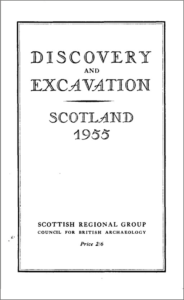
The first “full” volume of DES. It had previously been part of the SRG newsletter.
The journal also contains a short report from the Royal Commission Ancient and Historical Monuments (sic) about the first complete survey of the summit of Traprain Law and two excavations, at West Plean and Castlehill Wood, both in Stirlingshire and a lengthier report from the Inspectorate of Ancient Monuments. Most of the finds and excavations had been prehistoric or Roman up to now but it is evident from this volume that concern for the state of the nation’s historic buildings is growing. There are reports about how historic buildings were facing a greater threat than that of the war, which was the economic cost of maintaining them and recognising the need to preserve these buildings, even if only by record. Another report is about the making of grants for the repair of buildings of historical or architectural interest. Grants were given in 1955 for sixteen different buildings in ten counties, including Provost Ross’s House, Aberdeen, and Newbattle Abbey, Midlothian.
Ten years on, and the DES for 1965 was beginning to resemble those of the current day. There were 185 archaeological contributions over 42 pages of the 60-page volume, and National Grid References (NGR) had appeared. The volume was edited by Dr Margaret EC Stewart, and still cost 2/6, or 3 shillings if posted out. Advice to contributors, which was not present in 1955, includes a request that contributions be brief; that the NGR should be confined to six digits and the letter prefix; states that illustrations cannot be used, and asks that reports on objects state where they are now, and that excavation reports state where the final report will be published. As the reports had become more detailed they contain much to give today’s archaeologist pause for thought. Many finds are ‘retained by finder’, and there is a report of ‘unauthorised digging’ into a ‘hitherto relatively undisturbed chambered cairn’ at The Ord, Lairg, which revealed human bone. More cheerily, early reports from Northton, Harris, by DDA Simpson, and Udal, North Uist, by IA Crawford, hint at what was to come from these sites.
Following the archaeological contributions there are reports from Royal Commission on the Ancient and Historical Monuments of Scotland (RCAHMS); the Inspectorate of Ancient Monuments (Ministry of Public Buildings and Works); the Archaeology Division of the Ordnance Survey; and the Scottish National Buildings Record (Ministry of Public Buildings and Works). There is also a progress report on Industrial Archaeology. Then there is the Scottish bibliography – six pages – and lastly a list of member societies of the Scottish Regional Group.
Not much seemed to change over the next ten years, with the 1975 edition having roughly the same number of entries (178), the same editor, and still arranged in counties and parishes, despite the switch to regions and districts which had occurred as part of the local government boundary changes in 1974. This was explained as follows: ‘The archaeologists and historians of some future date will have to wrestle with the problems of relating the new local government areas to the old. But we see no point in inflicting them on our readers or on ourselves prematurely.’ Longer reports were now present for significant sites, notably the Oronsay shell middens; the Field School’s work at Strageath Roman Fort; and Anna Ritchie’s excavations at the Knap of Howar, Papa Westray, Orkney.
By 1985 the new administrative boundaries had been adopted – this change happened in 1978, which also saw a change of editor from Margaret Stewart to Edwina Proudfoot. Three hundred entries took up 68 pages and there is a mix of long and short entries, with a short description of each entry after the site name, and any sponsor named at the end of the report. The reports at the end were from RCAHMS, which included a list of buildings under threat; and a summary of the number of people accessing the National Monuments Record of Scotland (NMRS) plus a paragraph on the accessions made in 1985 and a list of reports and manuscripts added to their collections. The price of the journal was £2, plus post and packing.

DES covers from 1965, 1985 & 1995
The DES for 1995 looks much more like that of today, in an A4 format, rather than A5, and with double columns of text. The change happened with the 1988 volume. Entries were arranged by regions, districts then parishes, and illustrations had appeared, mostly black and white line drawings of site plans, artefacts and location maps. Now edited by Colleen Batey, there were 599 entries in the archaeological contributions section, covering 108 pages. Treasure Trove finds were being reported now, with details of the museum to which they have been allocated. The reports following the archaeological contributions include a short paragraph, under ‘National Surveys’ on the Archaeological database for Scottish Raised Bogs in Mainland Scotland, followed by a lengthy report, with photographs, from RCAHMS with news of their archaeological surveys, aerial photographic surveys and an afforestable land survey. There is then the news of accessions into the archaeological record, photographs, drawings and reports. This volume of DES also has a subject index to the archaeological contributions.
The new millennium saw the New Series of Discovery and Excavation in Scotland begin with the volume for 2000, by which time Robin Turner was the editor. The layout and format is essentially the same as today, entries are organised by local authority area, then parish, although the parishes do not have headings as they do now. There are photographs as well as plans and maps, and around 825 entries in the 143 pages of Archaeological Contributions. Similarly, DES 2015, edited by Paula Milburn, had 766 entries in the Archaeological Contributions section, spread over 178 pages, then chapters from Historic Environment Scotland and National Museums Scotland (radiocarbon dates from material handled by the museum).
The newest volume, Volume 24, which will be with you soon, has 900 archaeological entries, a report on Historic Environment Scotland’s year, structured around Scotland’s Archaeology Strategy; and reports from National Museums Scotland on radiocarbon dates and from the Treasure Trove Unit on assemblages declared to Treasure Trove and allocated.
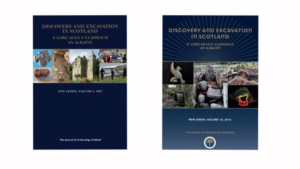
The new series, which started with DES 2000, brought in a new look.
DES is made possible thanks to the support of Historic Environment Scotland
Please fill in our quick online survey on how we can improve DES for the future, your feedback is vital – thank you: https://www.surveymonkey.com/r/ASJournalDES