
New Audiences – Wellbeing and Welcoming in Archaeology
Archaeology Scotland in partnership with Amina Moti have been working on a new project in Dundee called Wellbeing and Welcoming in Archaeology. Thanks to funding from NHS Tayside’s Charitable Foundation and HES Partnership Fund Support, we have been working with a group of ESOL Learners in the city. We’ve been able to continue survey work in Balgay Park and 4 learners from previous projects with the Dundee International Women’s Centre and DigiTay returning as mentors. The group have been fantastic at creating a very fun learning atmosphere and have got stuck into activities including artefact handling, historic map regression and exploring Dundee’s wonderful greenspaces through Health Walks. The project is focused on creating an environment which supports the groups wellbeing, making greenspaces more accessible and bringing together archaeological learning and English language learning to improve social connections. Archaeology is a great vehicle for conversation and placemaking, two things that are key for newcomers to Scotland to have an opportunity to take part in.
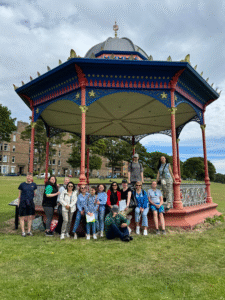
The group at the bandstand in Magdalen Green
Our base in the wonderful Grade A listed building The Vine, an 1836 Greaco-Egyptian styled house built by George Duncan MP, provides a great historical setting for discussing Dundee’s industrial past and the conditions that necessitated the provision of public greenspaces and the importance these places have in Dundee’s story.

Violetta working on her sketch of three of the sculpted stones moved into the park, seemingly, from St Mary’s on the Nethergate after the church was renovated in 1870’s
We have been out and about at Magdalen Green, Dundee’s oldest public park, exploring the paths and development of the area, land expansion and the beautifully restored bandstand. At Balgay Park we’ve been looking to continue our survey work from the Recording Balgay Park project of 2024 and are in discussions with The Friends of Balgay Park on how best we can support their work in the park going forwards. We have begun recording some of the many and fairly mysterious pieces of sculpted stone in the park, which seem to have been moved from churches including the fire daaged St Mary’s on the Overgate. Both of these parks reflect a tradition of greenspaces, public spaces, leisure and social interaction and through looking at these places we can tell the story of the city, industry, people and wellbeing.
The project will continue into August with more of a focus on co-designing the final workshops and bringing together what the group have learned and what they would like to explore in and around Dundee.
Feedback from Our Wonderful Attendees!
- “I enjoyed exploring the maps and seeing how Dundee has changed over 300 years.”
- “I now know lots of facts about Dundee and surroundings, history and English language.”
- “It is fascinating to work like a detective, piecing together clues from the ground to build a picture of the long ago, I also enjoy teamwork and learning new skills.”
- “The project ESOL and archaeology is very interesting and important for me. Because this project give me a new knowledge about Scotland and Dundee.”
Shelley McCarthy, Charity Chief Officer, NHS Tayside said:
Improving health and wellbeing doesn’t always start in a clinic, sometimes it starts in a park, with a map, a story and a sense of belonging.
Today I had the pleasure of visiting a project we’re proud to support: Wellbeing in Archaeology programme, led by in Dundee.
This incredible initiative is rooted in a simple but powerful idea, that archaeology can support better mental, emotional and social health.
Over 12 weeks, participants including asylum seekers, refugees and BAME communities come together to explore Scotland’s past while building healthier futures. Through outdoor archaeological surveys in places like Balgay Park, guided health walks, artefact handling and team-based learning, people are:
✔ Strengthening their mental health through connection, purpose and curiosity
✔ Reducing social isolation and building meaningful relationships
✔ Boosting physical activity through green space engagement
✔ Improving confidence and communication, key to overall wellbeing
This is holistic health in action and it’s a brilliant example of how partnership working can support prevention, empowerment and inclusion in our communities.
Thank you to the team at Archaeology Scotland and to the participants who shared their experiences so generously today.
Thank you to all who got involved!
Supported by:


By Kieran Manchip