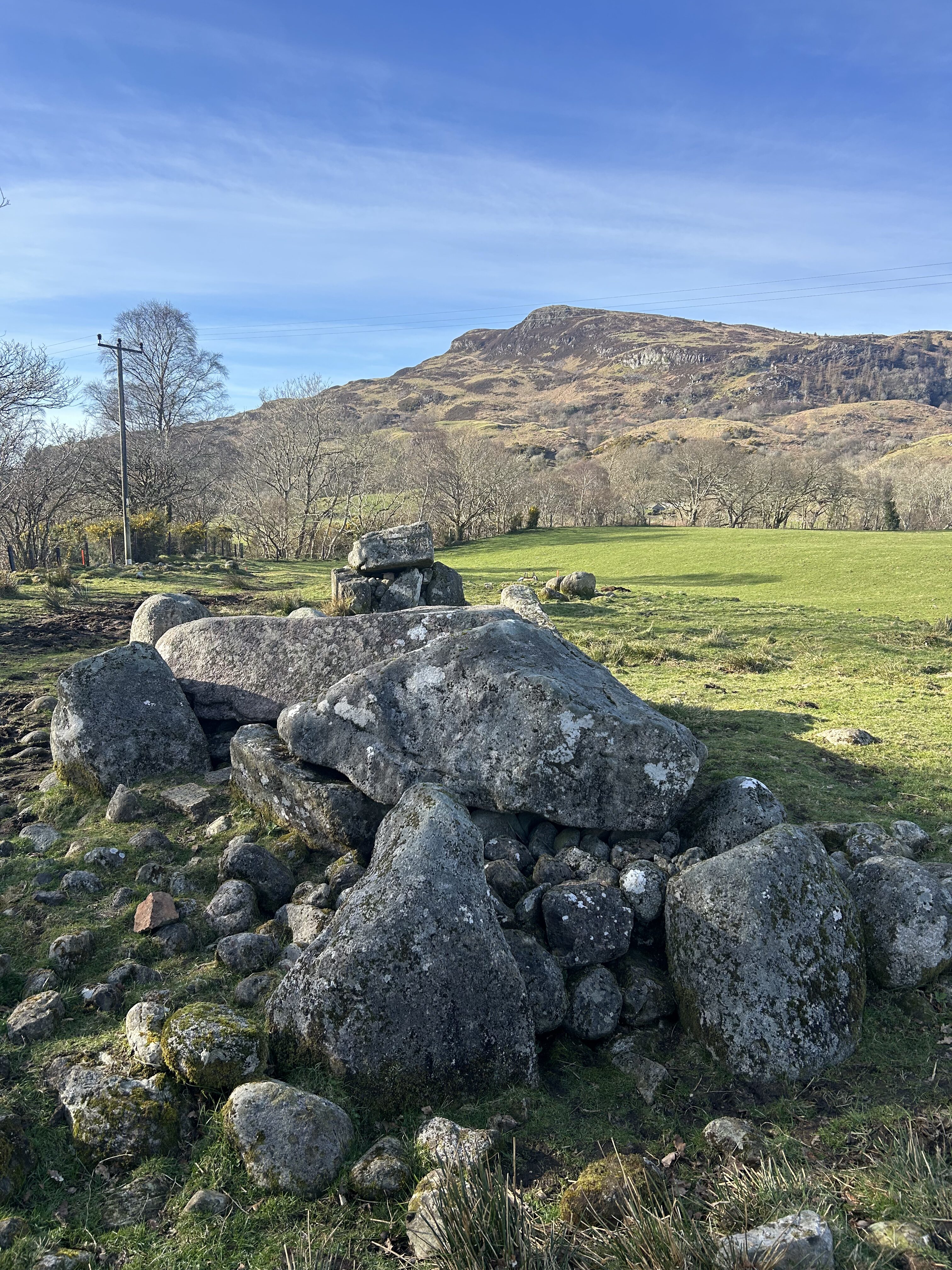
After delays and disruptions, finally setting out for the west coast of Scotland for the first of our Earliest Megalithic Monuments excavations should have been hugely exciting, but I just feel relieved to be on the way. As we arrive in Argyll, kit packed, permissions in place and volunteers ready, we can start to consider releasing the breath we’ve been holding for the last two weeks. The excitement starts to kick in the next day, when we first arrive on site. It rained overnight and today is grey but dry with only a slight spring chill in the air. Phil spots the cairn first, and points it out, disguised as it blends into the tree line in the distance. It is perfectly framed by the hills behind it, held up by the natural undulations of the field it sits in.
Reality sets back in as we make our way over. Pools of water are visible down the slope and my feet fully submerge in mud in a particularly boggy patch beside the cairn. Two chambers are visible above the ground surface, and the remains of the cairn material covers a large circular area underfoot. The first chamber we come to after passing through a gateway is the ‘passage grave’, a chamber made up of a series of larger stones with a possible entrance, capped with two more large stones and filled with smaller ones. Walking beyond the passage grave to what would have been the centre of the cairn, we get a better look at chamber 1, a simple chamber sitting slightly taller, with large stones creating a tight inner chamber and balancing an enormous capstone. We can see the edge of where the cairn would have extended to, before generations of people took stone from the cairn to build everything from field boundaries, to houses or farm structures. We see the remains of some of these in the neighbouring fields and just to the other side of the fence line from where we stand. While we know it has, to some extent, been reconstructed after its initial excavation, the fact that the chambers are still standing, is really impressive. I have to keen reminding myself that these would not have been visible for a significant part of the monument’s life, as they would have been surrounded by these rounded stones that little the ground, make it much larger monument, and likely even more visible from afar.
We are here to investigate Achnacreebeag as part of Archaeology Scotland’s Earliest Megalithic Monuments Project, funded by the Audrey Henshall Legacy Grant from the Society of Antiquaries of Scotland. This site is the first of three chambered cairns lined up for excavation in partnership with their local communities, and we are hoping to investigate the archaeology of the area surrounding the monument, as well as one targeted trench to look at the phases of the monument’s construction and use. Achnacreebeag in particular is interesting to us as, when it was surveyed by Henshall in 1961, it was not easily categorised into a particular type of chambered cairn. The site was also excavated by a RCAHMS team lead by Graham Ritchie between 1968 and 1970. Through three seasons, they identified the extent of the surviving cairn material, and removed the capstones to excavate both chambers. The results of the excavation suggested that the monument had been constructed in two phases, with Chamber 1 in the centre of an original circular cairn, with some of the kerb surviving. Ritchie et al. argued that the passage grave was added later, and the cairn extended to cover it, leading to the more oval shape now seen in the surviving cairn material.
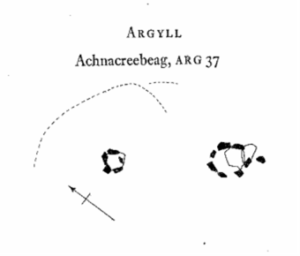
Audrey Henshall’s plan of Achnacreebeag
The volunteers set to power our work at Achnacreebeag are members of, or recruited by, the Lorne Archaeological and Historical Society. The Society was originally founded in 1963 and has a long history of being driven by the work of female archaeologists. Margaret Kay (pictured below next to Achnacreebeag passage grave), was a key figure in establishing the society. She was society secretary from 1963 until 1988, when she became the society chair, a position she held until 1999 when she was elected to the specially created role of President of the society, in recognition of her central role within the society. This was also the year that Alison Blackwood began her six year stint as secretary to the society. Alison visited us on site and kindly shared some of her memories of both the LAHS and of her time on the summer schools run by Archaeology Scotland (then Council for Scottish Archaeology). Continuing this legacy today is Jill Bowis, the current society president. Recruiting to the committee has been an ongoing issue, but the society remains active running a range of activities connecting people with their local heritage and generating new research into aspects of the area’s past.
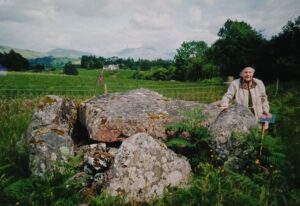
Margaret Kay at Achncacreebeag (Image Credit: LHAS and Alison Blackwood)
In week one, our local community volunteers opened up a long trench, cutting across the rigg and furrow down the slope from the cairn. This trench was mostly empty of finds, but uncovered two further drainage ditches, similar to those identified by Ritchie’s excavation. Some of the volunteers also walked in the footsteps of Audrey Henshall, completing an updated survey of the cairn including creating new descriptions of the stones, and photographing them to record their position and condition. Then in our second week, our participants helped to confirm our findings from Trench 2 by opening test pits, identifying one drainage ditch but no evidence of Neolithic activity. The second week also saw us open up the trench next to the chamber. Here we were able to uncover some of the surviving cairn material, as well as to look at how the chamber had been constructed. We identified some stones that would have formed part of some dry stone walling between the large upright stones, as well as chock stones used to keep these uprights in place. This trench overlapped with the area uncovered by Ritchie’s excavations, so we didn’t expect large numbers of finds, but this work gave us the opportunity to collect new material for dating, using methods not available in the 1960s. To get a date for the construction of the cairn, we need to identify the earliest phases of the monument. We were able to take soil samples from around and below the cairn material, as well as around the large upright stones, sampling material that would have collected around, or been deliberately placed to support, these stones. Visiting us at the site, were a team from Durham University, who took samples for OSL dating. OSL dating works by looking at the last time light touched a soil. This method presents an exciting opportunity to get a date for the construction of the chamber at Achnacreebeag, and means we don’t have to rely solely on potential organic material from out soil samples.
We were also lucky enough to work with David Craig, a specialist in aerial photography and mapping, who created drone photogrammetry models of the site, as well as other chambered cairns in the area. You can view David’s 3D models here: Archaeology Scotland – A 3D model collection by HeritageNI – David Craig (@heritageNI) – Sketchfab, and keep an eye out for updates on our results from the excavation on our website and social media.
Supported by the Society of Antiquaries of Scotland’s Audrey Henshall Legacy Award and Historic Environment Scotland.