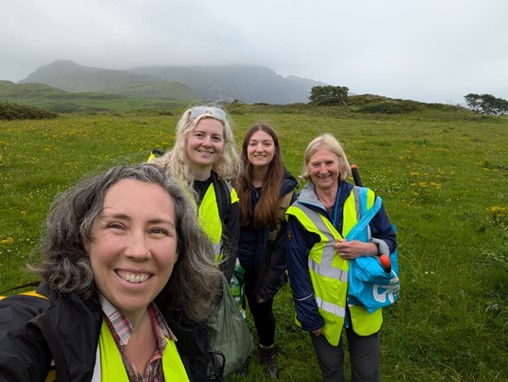
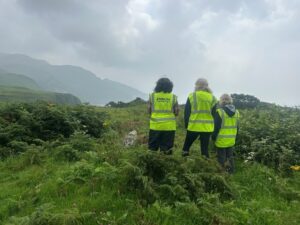
Hannah, Katie and Penny at the Cairn
On the south side of Ardnamurchan, not far from Kilchoan is a monument that was not recorded by Audrey Henshall but bears striking similarities with the chambered tombs of the peninsula. As part of our celebration of Audrey Henshall’s legacy, I am heading out to record this monument just as she did so many others. Joining me are three women from different areas of archaeology, each with their own connection to the site and Ardnamurchan itself. The first, Professor Hannah Cobb of the University of Manchester, some readers may know from out last blog post. Hannah is a co-director of the Ardnamurchan Transitions Project (ATP) and first drawn to Cladh Aindreis (the site of the project’s first excavations) by the survey and description produced by Audrey Henshall. Also with us is Katie Sanderson; Katie is a Project Officer with Oxford Archaeology and a graduate of the University of Manchester. She first came to Ardnamurchan in 2016 as an Archaeology student and has since returned to the project in her spare time. She sits on the board of directors for the Chartered Institute of Archaeologists (CIfA) and as part of CIfA and Oxford Archaeology respectively, has been involved in initiatives revolving around supporting Early Career archaeologists and EDI.
When we park the van close to the site, we meet up with the final member of our team, Penny Horner. She is a long-term volunteer with the Ardnamurchan History and Heritage Association (AHHA) and their current secretary. Penny is not only providing the tools but offers to drive us down closer to the site in her car. This site was discovered by Ricky Clark, a member of AHHA, while walking his dog. The site was initially surveyed by the group in 2014, but we are keen to see the site for ourselves, compare the current state of the site to their record and to conduct new types of survey now available, such as creating a 3D scan of the visible remains. To be able to do any of this, first we need to find it…
The cairn isn’t immediately visible as we walk into the field. We set to work clearing the bracken and brambles covering the area where we expect the visible remains of the cairn to be. Our educated guess as to where to begin is informed by Penny, who has visited the site before, and by photographs taken by the AHHA during their survey. As we see more and more of the stones that make up the cairn, we realise the monument is bigger than we expected. Thankfully the job of clearing the area is sped up by working in a group and not just because we have more hands. We fill Penny in on our whale sightings from the day before, and she tells us about the newly opened coffee shop in Kilchoan. And there is a real sense of discovery as we bring the final arrangement of stones into view.
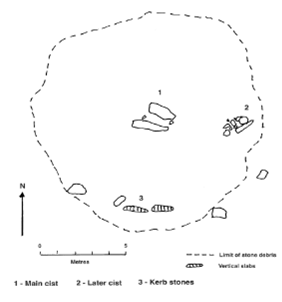
Plan of Erickson’s Cairn (AHHA 2014)
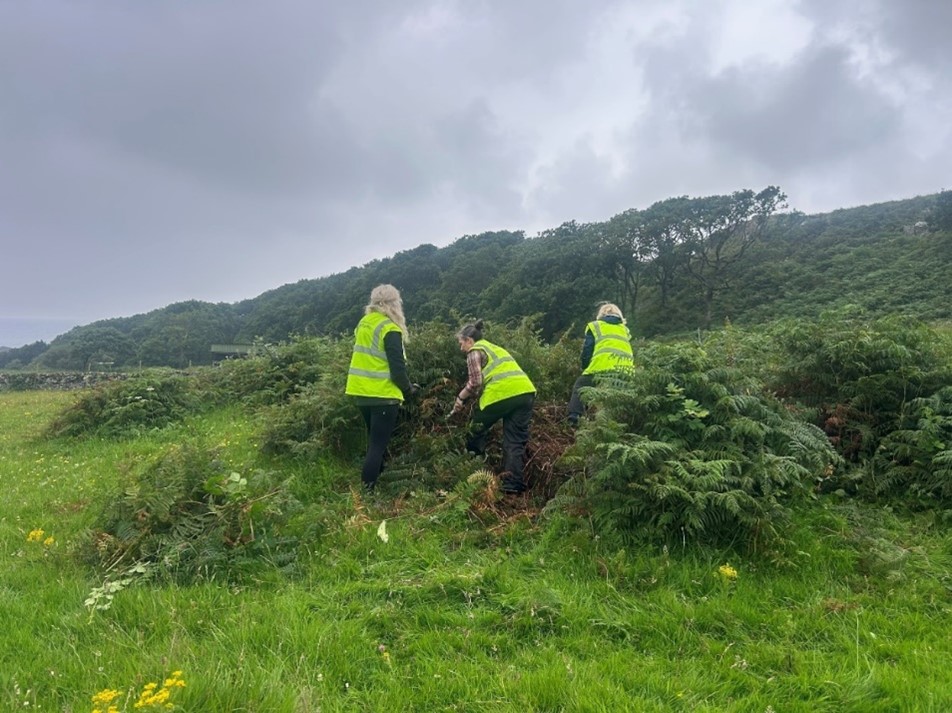
Katie, Hannah and Penny clearing vegetation covering the cairn
Job complete, we take a new look at the site. One of the first things that jumps out is the setting. On the walk up we were focused on finding the monument within the sea of bracken, but now we can take it all in. The sky has been heavy with rain all morning, but the sun is tentatively breaking through and the clouds are starting to lift. The tops of the mountains still have a light shroud but we can now look out to sea, where when we arrived we just saw a haze of grey.
“It’s so dramatic” says Katie. The landscape, she explains, is a part of her love of working on the peninsula. “There’s something deeply inspiring about monuments by the sea…The visibility of the stuff across the sea really puts you and the archaeology into the landscape in a way that you can’t ignore”. We all agree. The mountains too are stunning, and Hannah comments on the alignment of the cairn with Ben Hiant, the highest peak on the peninsula. It isn’t difficult to imagine the appeal of building in this spot.
We are all impressed with the cairn’s condition, with little evidence of plough damage. Two upright stones remain in the centre, with a clear second collection of stones forming what could be a later cist burial, inserted into the side of the monument. We assume that at some point the site has been robbed, perhaps to construct the boundary walls behind us, but both Katie and Hannah have seen many sites that have been damaged more significantly by later activity. Penny suggests that in the last couple of centuries, the site may have been within the area of a deer park. This would have offered it some protection from damage from agriculture but also meant that it was never declared or entered onto Ordnance Survey maps or monument records.
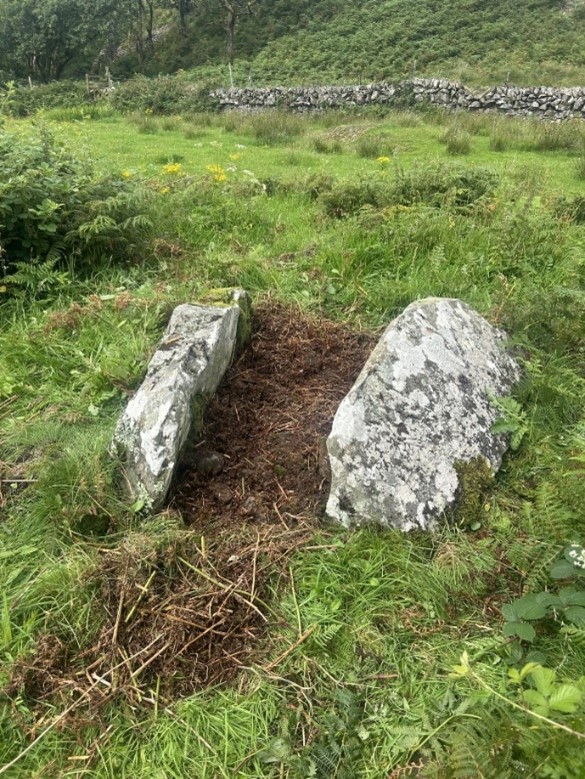
The main area of the cairn now visible (1)
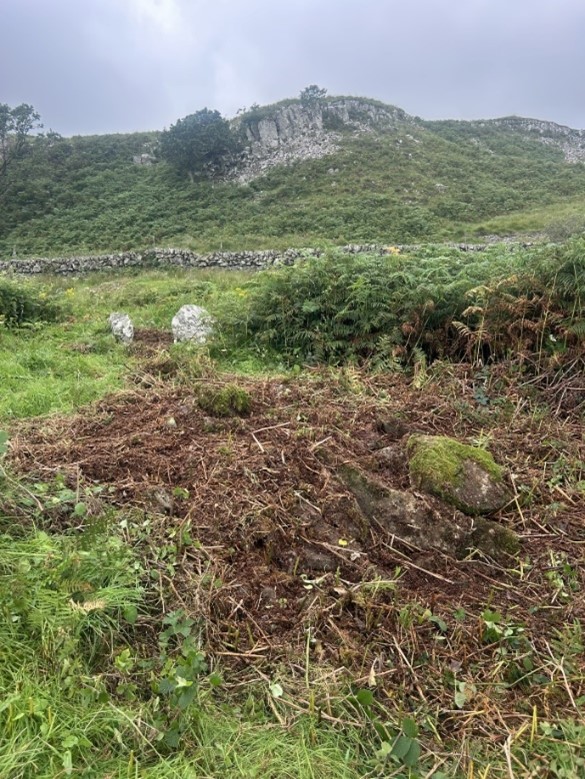
The main area of the cairn now visible (2)
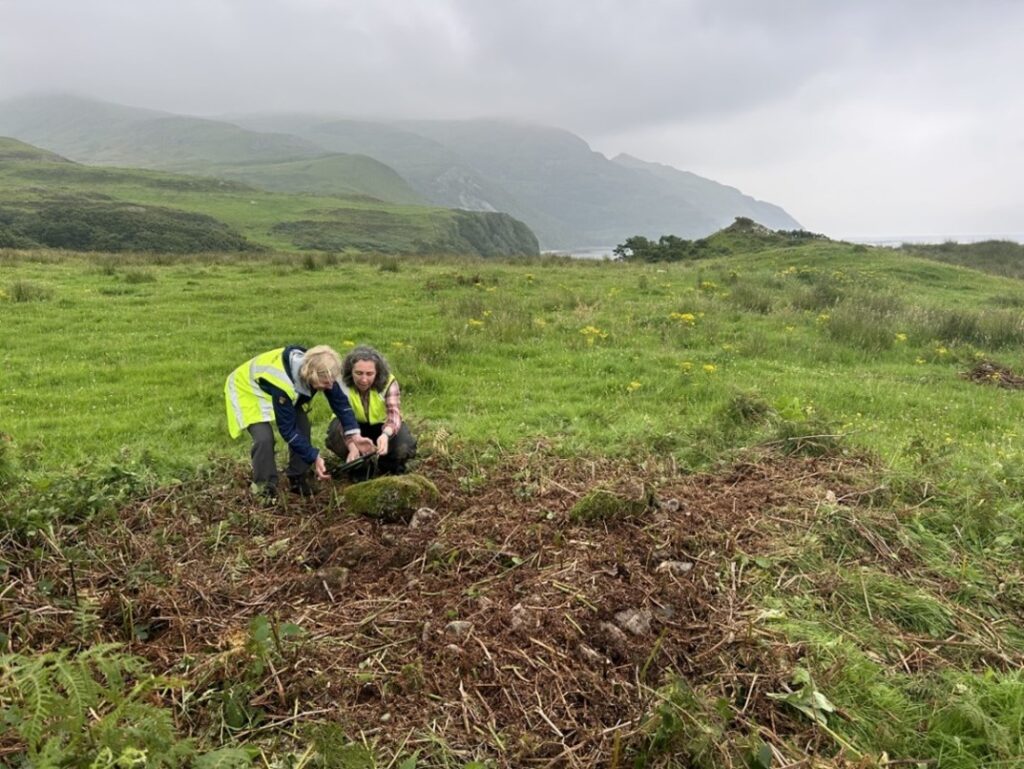
Penny and Hannah completing a photogrammetry survey of the site using a 3D scan
As archaeologists of different backgrounds, our questions and priorities approaching a survey like this are all slightly different. We agree that taking measurements and GPS points to record the surface features as well as a photogrammetry scan of the site are both essential. These will allow us to take the core information about the site, create a baseline for assessing future damage and to allow us to form some initial interpretation about what type of site this might be. Katie suggests that she would be interested in a walkover survey, looking for other points of interest in the surrounding area. For Hannah, the role of archaeological survey in teaching and training is also key. She views being about to conduct a survey like this as a key skill, and a monument like this with so many intact elements as an exciting learning opportunity if students were involved. We consider what else we’d like to know about the site. My mind immediately goes to dating the site, and how amazing it would be to know how old it is and put it into the picture of what we already know about what was happening here thousands of years ago. Katie raises the question of material- what could potential finds from the site could tell us about the people who used or lived in this landscape thousands of years ago? Penny also suggests considering the monument in the context of others in the area, such as Greadal Fhinn and Cladh Aindreis, to consider the similarities in the form of the site. Are these the same type of monument?
Many elements of how we conduct a survey are unchanged from when Audrey Henshall set out to conduct her fieldwork on the Neolithic monuments of Ardnamurchan. The importance of taking measurements as well as noting the position of a site in the landscape and the past uses of the land are unchanged. As are many of the practicalities of working outside in Scotland.
“The thing that I often think about is that they didn’t have lightweight waterproofs in the 1960s”, says Hannah. Another key element of surveying, as we are proving ourselves while we work at Erickson’s Cairn, is both the importance of working in a team and the continued relevance of local knowledge. We only know about this cairn as a result of Ricky’s discovery and our work today was informed by the AHHA survey from 2014. In terms of even more practical matters, Penny suggested where we could park, brought tools we were missing and helped us get here. We assume that the same must have been true for Audrey Henshall; no records or descriptions can be replacements for a lifetime of familiarity and a guide to walk you across their turf in person.
For Penny the community of Ardnamurchan, both past and present, are central to her passion for heritage: “I’m just fascinated…by everything related to the community and continuity, how people in the past have seen this but also the people coming in”. She reflects on the experience of women like Audrey Henshall coming in and working in this landscape and gives the example of MEM Donaldson, a photographer originally from England, who moved to Ardnamurchan and documented the lives of people on the peninsula. “She was accepted because she was very generous and outgoing and she was interested in people”, Penny says. Katie adds that she has felt this acceptance herself, in contrast to how she often feels as a commercial archaeologist. “It is really special to me to feel included in the history of [Ardnamurchan]” she says. Hannah agrees, “You can’t help but see yourself as just a single dot in the long web of millions of people’s entanglements with the place…It’s really lovely to think about past people in the landscapes and then the endeavours of people like Audrey Henshall as part of all of those entanglements”.
When I have thought of these connections before, I have mostly focused on what draws people in. We’ve discussed the archaeology, the community and the landscape, all are incredibly special. But Katie also describes how she has taken what she has learned from working in Ardnamurchan into her work as a commercial archaeologist: “I’m laying out trenches based on things I’ve learnt up here and finding new prehistoric sites because of it”. The impact of the project has also seen people take so much away from their time in Ardnamurchan, in many cases learning from people working in different areas of archaeology or at different stages in their career. These sites have played a key role in training possibly hundreds of this generation’s archaeologists, something not many field schools can claim. Maybe one day, in a few years time, Erickson’s Cairn may be part of this story too.
Today, in our own small way, we have added to this history of Ardnamurchan, building the record of the people who once lived and died in this landscape. We say goodbye to Penny, and head to get a coffee. Later, on a rushed ferry journey to Tobermory to buy loaves of bread for hungry students, we all turn and look for the cairn, trying to pick out the stones or the vegetation from the sea. We realise we’ve all done the same thing. We are all still thinking about the site, trying to gain another perspective on it and how it may have bene seen by not just the people who built and used it, but also those who have come since and also asked questions of these arrangements of stones.
From Left to Right: Hannah Cobb, Katie Sanderson, Eleanor Harrison, Penny Horner (Hannah Cobb)
For more information
Ardnamurchan Historical and Heritage Association: Heritage Ardnamurchan – Celebrating the History & Heritage of the Ardnamurchan Peninsula
Supported by the Society of Antiquaries of Scotland’s Audrey Henshall Legacy Award.