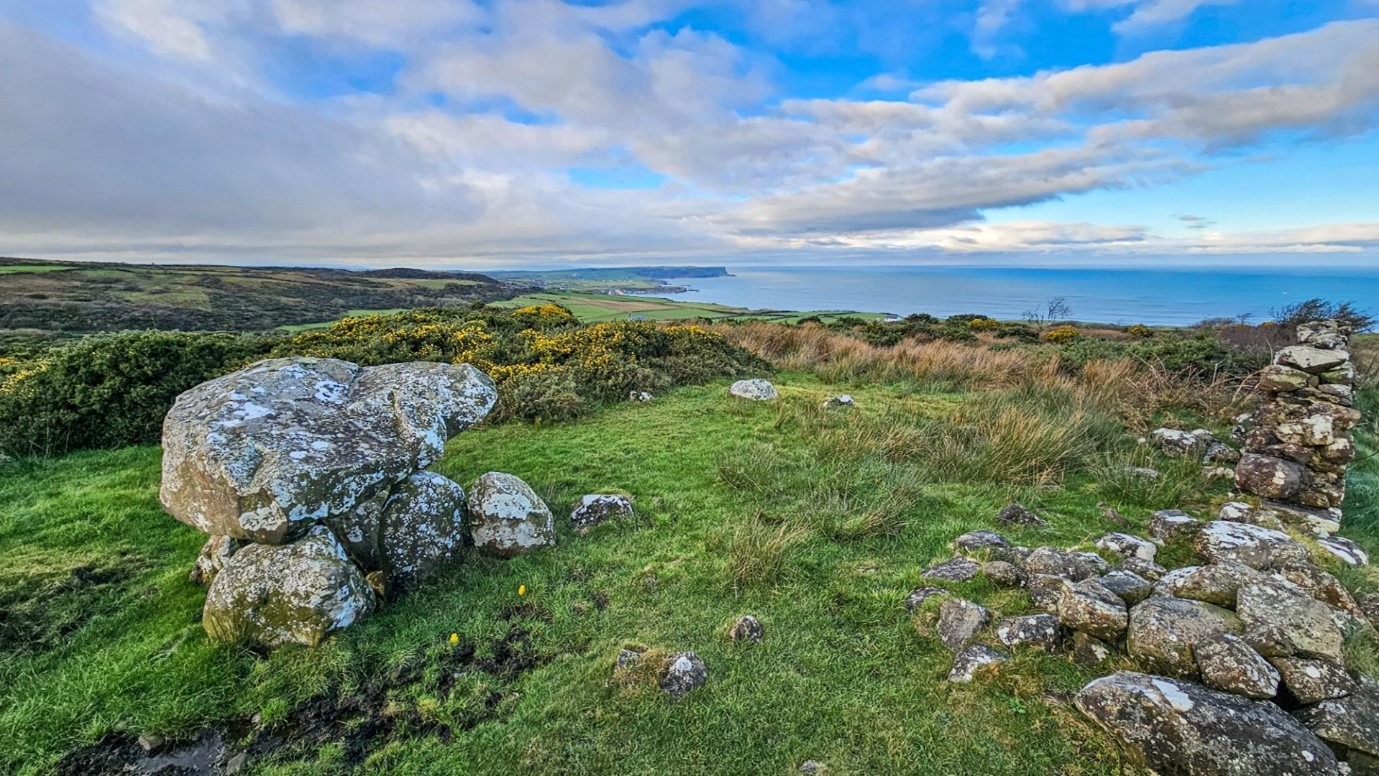
Photo: David Craig
This February (2026), we headed to Ballintoy to visit a dig that has shed new light on an ancient passage tomb near Ballintoy.
An Early Neolithic monument, perched above the N Antrim coast, has been yielding up its secrets thanks to a project, ‘From Brittany to Ballintoy’, funded by the Research and Revival Scheme of the Historic Environment Fund, N Ireland. The ‘Druid Stone’, formerly known as ‘Mount Druid cromlech’ – though it has absolutely nothing to do with Druids! – is a simple passage tomb of a type known from various places along the west coast of Britain and around the coast of the northern part of Ireland. A find of southern Breton Late Castellic pottery at one of these tombs at Achnacreebeag near Oban points towards Brittany as an area of origin for their builders.
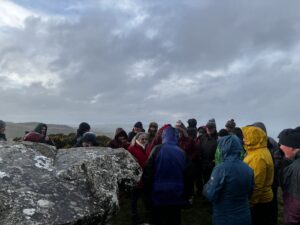
Keen and intrepid visitors to the site on 20 January, a wild, wet and windy day! Photo: Grace McAlister
Excavations at the Druid Stone by John Mogey in 1939 uncovered a charcoal-rich layer containing flint and cremated human bone around much of the monument’s exterior, but sadly all his finds have been lost. The new excavation, by Dr Cormac McSparron with Dr Alison Sheridan for Archaeology Scotland, was undertaken between 20th and 22nd January, in challenging conditions, to obtain dating material that could show when the passage tomb was built. To this end samples for Optically Stimulated Luminescence were also taken, by Dr Florian Cousseau and Professor Chris Scarre, for an international Durham University project called Megalithic Origins: the emergence of monumentality in Neolithic Western Europe, led by Dr Marta Diaz-Guardamino.
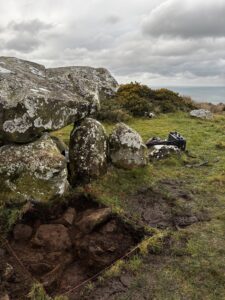
View of the trench immediately outside the chamber. Photo: Grace McAlister
The results have been spectacular so far! The dig relocated the black layer and found the same range of materials, so radiocarbon dating of short-lived species charcoal and of cremated bone can be carried out. It also demonstrated that this layer and its stone capping ran over, and therefore post-dated, the packing stones for the passage tomb uprights, and it also showed there had been no cairn between the tomb and its circular kerb. Secondary activity was also found: some time between 2300 and 2000 BC, sherds of a Beaker pot were placed in a small pit dug into the black layer. Dr Sheridan will return to the area Tue 3 March at 7.30 to lecture in Ballintoy; meanwhile, a pre-excavation radio interview for Radio Ulster’s Kintra programme, broadcast on 1 February, can be downloaded from https://www.bbc.co.uk/sounds/play/m002qt8j and accessed until the end of February on https://www.bbc.co.uk/sounds/brand/m00000p2.
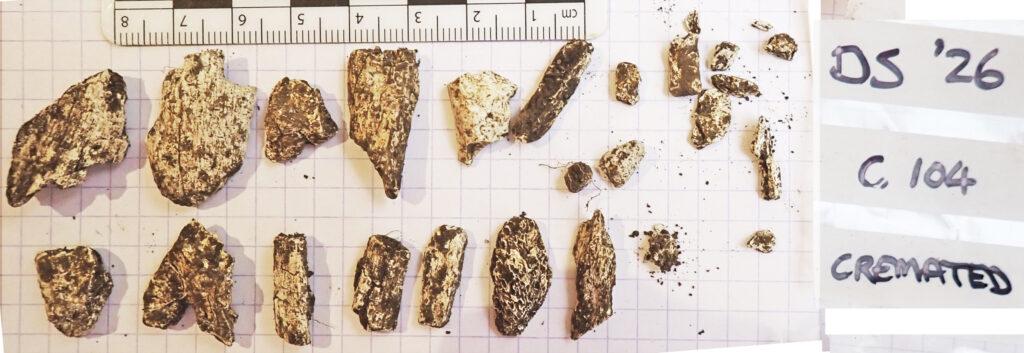
Some of the calcined human bone found in the black layer. Photo: Alison Sheridan
The From Brittany to Ballintoy project is part of a broader research initiative, Boyne to Brodgar, which includes a £50K project, Scotland’s Earliest Megalithic Monuments, led by Archaeology Scotland and funded by the Audrey Henshall Legacy Fund administered by the Society of Antiquaries of Scotland. Watch this space!
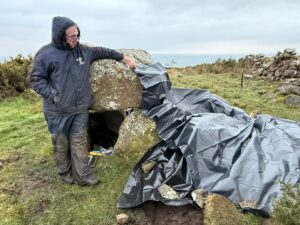
Dr Cormac McSparron holds the light-blocking tarpaulin in place while Dr Florian Cousseau samples for OSL. Photo: Professor Chris Scarre
Blog by Dr Alison Sheridan