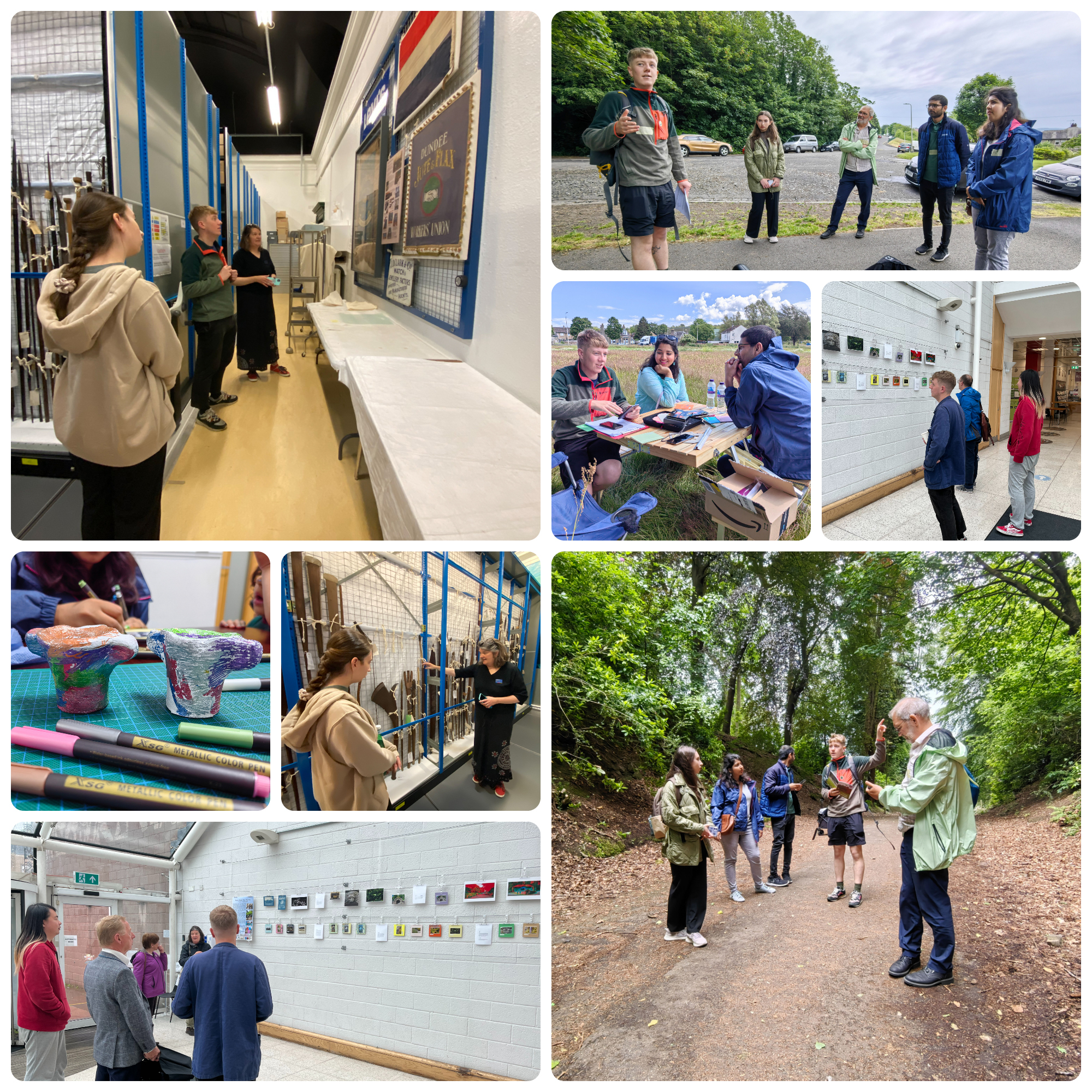
In the last three months, Kieran Manchip and I held five events in Dundee to explore photography and archaeology as a part of the New Audiences Project. Right now, in Dundee Central Library, our outcomes of these events are displayed as the exhibition “Perceive – Pixelate – Print – Post – Past”.
This exhibition will be at the Victoria Rd Entrance until the 2nd of September, 2023. The participants used different photographic techniques to create this series of artworks reflecting their experiences learning about the fantastic built heritage within Dundee. Through these five workshops, the project sought to give participants the opportunity to learn about their new home city and learn, experience and be creative with photography.

In the first activity in Balgay Park, I taught the participants some basics of photography, such as how to get the correct exposure, a stable and clear image, and some simple ways of composition. After familiarising themselves with these basics of photography, they experimented with using an iPad for laser scanning modelling and a light field camera to record depth information of the environment.
At Balgarthno Stone Circle, I lead them to try and learn polarisation photography for archaeological records and produce beautiful abstract images from it.
At the McManus Collections Unit, we also experimented with some other methods for photogrammetry and used polarisation photography to compare the differences between the materials of various parts of ancient Egyptian and Roman textiles. In polarisation photography, small differences between materials of similar colours are highlighted, while differences between the same material of different colours are weakened.

Before the end of each event, we printed out some of the pictures taken that day and made them into unique handmade postcards. For the last event, we recreated the images taken during these events using a different printing method. Digital models of artefacts obtained through laser scanning were printed using 3D printers and provided to children for doodling. Some pictures are made into three-dimensional pictures that can be directly viewed through lens printing; others are compared with historical pictures and printed through the red and blue method so that people can intuitively compare changes in historic sites over the decades and centuries with the help of red and blue three-dimensional glasses. In addition, we also tried cyanotype printing, which is one of the oldest photography methods, and it is also non-toxic and the simplest method, which is very suitable for family activities to experience the charm of ancient photography. In the end, these prints and the postcards constitute our exhibition.

Through this series of activities, I am very happy to share my expertise with the public and have more diverse practical opportunities. During my time working with Archaeology Scotland, I learned some of the archaeological industrial rules. Until then, I had only seen vague theories of these rules in books, and it was not clear that they were used in practice. At the same time, this project has also brought sustainable help to my career development. Not only have I connected with a group of professionals related to my research, but I have also been able to feel the feedback from the general public when faced with different depths of expertise. These can help me to better conduct research in the future and better communicate my research results to a wider audience. It has also enhanced my teaching experience and made me more aware of the range of expertise required and acceptable to audiences at different stages.

Finally, a big thanks to our participants. Moreover, I’m very grateful to the Scottish Graduate School for Arts & Humanities and Archaeology Scotland, who provided me with this opportunity. I’m also thankful to Historic Environment Scotland, Leisure and Culture Dundee, Friends of Balgay Park, The Scottish Refugee Council and the Dundee International Women’s Centre for their support in making the project happen.
Article by Sihao Fan | Archaeology Scotland
August 2023