
The weather is perfect as our ferry leaves Oban, the sea flat and gleaming under the spring sun. It’s a long crossing to Barra ahead of us, but we soon lose sight of the skyline we recognise from out last excavation at Achnacreebeag. Dark green hills peel back, eventually giving way to the volcanic coastline of West Ardnamurchan. It is a strange feeling to sail past the lighthouse, the western-most point of mainland Scotland, knowing how remote it felt on land. We turn our attention to the Small Isles to one side, as the coastlines of Coll and Tiree are at out backs. The sun is still shining an hour later when we reach Barra, and we are treated to a beautiful Hebridean sunset for the final leg of our journey, crossing to Eriskay and then via the causeway to South Uist.
We are headed this week to work at Leaval chambered cairn, on South Uist in the Outer Hebrides. This site is the second we are excavating as part of the Scotland’s Earliest Megalithic Monuments Project funded by the Audrey Henshall Legacy Grant from the Society of Antiquaries of Scotland. Leaval was surveyed by Audrey Henshall in 1960s, as part of her second volume of the Chambered Tombs of Scotland (1972). The site was later excavated by a team from Cardiff University, led by Vicki Cummings and Niall Sharples. Like the small chamber at Achnacreebeag, the interpretation and classification of the monument were uncertain, and the possibility left open that it was unusual as it could be a notably early example of this type of monument.
The next morning we head out to the site for the first time. Rugg-Gunn, who made the first record of the site in 1937, notes that the surrounding area the site was known locally as ‘the graves’ with the monument itself ‘the witch’s grave’. He suggests that the Gaelic name, Leac-na-bana-bhuidseach, could be translated as “the witch’s table stone” and is perhaps a reference to a capstone that is now missing. Large boulders do litter these fields, and I’m comparing each collection with how I remember the monument looking in the photos I’ve seen. When we finally spot it, it is obviously manmade and different from what surrounds it. The upright stones sit alone, on an area of raised ground, only visible as we come up onto the ridge from the south. Four large stones create a small inner chamber, and some remains of the cairn material are still visible above the grass. The monument is surrounded by higher ground to the south, hills to the east and north (we even spot the Isle of Rum on a clear day!) and then is open to the machair and the sea on the west.
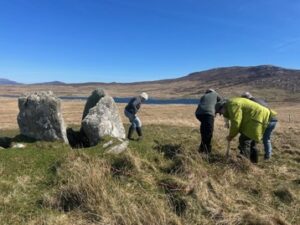
Our small team is made up of members of the Uist Community Archaeology Group, and a mix of experienced diggers and first time archaeologists, and on the first day we jump straight into deturfing our first trench just outside the chamber. Just removing the turf starts to reveal the cairn material, and as we clear the remaining topsoil the following day, two distinct layers of stone begin to emerge. We can identify both the remains of the cairn, and the line of a later enclosure identified in the previous excavation. Impressive as the chamber is as it currently exists, it surely must have been an even bigger part of the landscape when the cairn was first built, although we can’t be sure how high it originally stood. Even just to the height of upright stones, it would have been seriously impressive, and stood out much more from the large boulders in the neighbouring fields. We do eye up these stones every day on our walk to and from site, however, just in case any could be an elusive capstone.
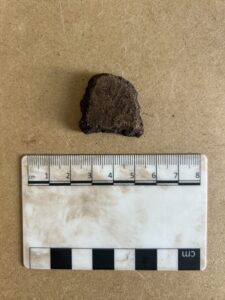
Our second trench was within the chamber itself, and a really exciting prospect! After working out the logistics of entering and exiting the chamber safely, and how to ensure we weren’t undermining the stability of the large stones now looming over kneeling archaeologists, we began to excavate around half of the chamber area. As a shorter member of the team, with slightly younger knees, I spent most of the week in the chamber. Initially it felt a little claustrophobic, with my feet constantly bumping into the upright stones, and those that sat on the surface digging into my shins. As soon as the topsoil had been removed, a fragment of prehistoric pottery came into view, resting tightly against a collection of stones that seemed to be part of the chamber construction, filling the gap between the larger upright stones. My discomfort from where I am sat is forgotten, but now the pressure of getting this right is looming over me instead. And the trench does not make this easy! Throughout the week pieces of flint and quartz turn up, but no more pottery, and more significantly a rounded cut feature, possibly a pit or a post-hole, with an unclear relationship to the chamber construction. Our hope is that soil samples taken from the lower fills of the feature will contain organic material that can be radiocarbon dated to help us identify which came first. Working in the chamber feels like a world away from the rest of the site at times, I have to fully stand up look out to see the other members of our team and crouched in the shadow of the stones but sheltered from the wind, I feel like I’m in my own micro-climate. Finding it hard to join in the general chat on site, I’m mostly listening to my own trowel scraping, intermittently broken by the sounds of birds flying overhead. One memorable day, I hear a strange call and look up to see a white tailed eagle flying low overhead, so close that there’s no possibility of it being anything else!

Later in the week, the finds all start to come from Trench 1, with fragments of pottery appearing in the area outside the chamber. We lift some of the cairn stones and take soil samples from the deposit underneath, which may represent an old ground surface onto which the cairn was built. In the top corner of the trench, we also identify a cut, into which the chamber stones were placed, as well as some smaller packing stones used to hold the larger uprights in place. We take soil samples from this area, and take a moment to appreciate that we are seeing the lower edge of these stones for the first time in potentially thousands of years.
It feels strangely ceremonial when we start to re-gather the stones to return them to the trench on our final day. We are reversing the work of the last week, but almost mimicking the original building of the monument, packing stones, then soil and then turf together. We carry all out kit back towards the van, along with our small treasures: a box of finds ready for analysis and some soil samples, full of possibilities for our unanswered questions.
Supported by the Society of Antiquaries of Scotland’s Audrey Henshall Legacy Award and Historic Environment Scotland.
Keep an eye out for future updates as our finds and soil samples are processed and sent for analysis. You can also follow the work of UCAG here:
– Blog By Dr Eleanor Harrison, Archaeology Scotland