
Discovery and Excavation in Scotland (DES) is published in May annually by Archaeology Scotland, launched at the conference we hold with the Society of Antiquaries of Scotland – Archaeological Research in Progress (ARP).
DES originated from the Annual Report of the Scottish Regional Group of the Council for British Archaeology. The first edition came out in 1947. This first appearance of Discovery and Excavation in Scotland was part of a nine-page newsletter, or annual report, reporting on the activities of the newly formed Scottish Regional Group and included a financial statement as of 31st December 1946.
In 1946 the Chair of the Group was Professor V Gordon Childe, and there were eight members of the Council and a Secretary. There were fourteen member societies within the Group, including Hawick Archaeological Society (388 members in 1946) and the Society of Antiquaries of Scotland (832 members), all of which paid a membership fee of ten shillings (50p). The accounts show the income from 1946 to have been £17 3s 8d, slightly in excess of expenditure (£16 15s 1d).
This first annual report also contained a paragraph on the need to start a Field School to train Scottish archaeologists. The first field school was proposed for the summer of 1947, following a pledge of support from the University of Edinburgh of £100 a year for the next five years.
The Annual Report also contains a paragraph on the proposed summer excursion to the Broch of Torwood, Stirling Castle, the Church of the Holy Rude, the Guildhouses and Cambuskenneth Abbey. There then follows the list of “Discovery and Excavation in 1946”, which I will return to later. Then, a short list of forthcoming excavations, a list of new publications, and a report on the progress of archaeological recording by the Royal Commission on Ancient Monuments (almost completed the inventory for the City of Edinburgh) and the Glasgow Archaeological Society (a volume on the Roman Occupation of SW Scotland). The national air photograph survey is reported on, with the observation made that to date, almost a third of Scotland has been surveyed.
Discovery and Excavation in 1946 occupies just under three pages of this annual report of the Scottish Regional Group of the Council for British Archaeology. Excavation reports are arranged by county and are typically very brief, detailing little more than the monument type, the names of the excavators, and a brief summary of what they encountered during the work. Where known, the publication in which the excavation is fully reported is listed at the end of the entry.
These reports show us the embryonic beginnings of the Discovery and Excavation in Scotland that we know and love today. Today’s entries are still organised alphabetically by region – albeit now we use Local Authority Areas and parishes. We still name the site, and what sort of structure or other discovery it is, as well as naming the main excavator(s). We provide much more detail on what was found, and the entries are much longer than they were in 1946. We no longer list the full publication details due to the much longer time that it takes to take a site to full publication today. However, the publication of the names of the organisations doing the work, whether a commercial company or a community group, allows readers a way of finding out more information.
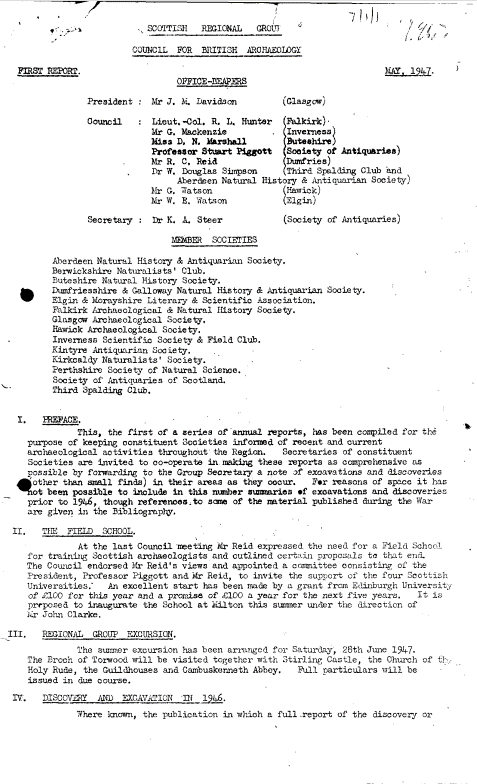
First edition of Discovery and Excavation in Scotland (1947)
Today Discovery and Excavation in Scotland (DES) provides the sector with a summary of archaeological work conducted in Scotland over the previous year in one accessible, nicely presented, illustrated book. It is easy to look up any area of Scotland you are interested in and see what new discoveries have been made. The index allows you to follow the progress of any sites, authors, or, indeed, site types that you have a particular interest in. The main section – “Archaeological Contributions”, is 185 pages long this year, so it has grown considerably since 1946! The volume also contains a report from NMS (National Museums Scotland) on radiocarbon dates, a list of excavation assemblages declared to Treasure Trove, and a report on Historic Environment Scotland’s main activities over the year.
In addition, we publish a list of students doing post-graduate research on Scottish archaeology as well as a list of the Local Authority Advisors in Scotland.
Volume 23 of Discovery and Excavation in Scotland, 2022 was launched in Edinburgh on Saturday, 27th May 2023, at the Archaeological Research in Progress (ARP) conference held at the St Augustine church on George IV Bridge.
Article by Jennifer Thoms | Archaeology Scotland
May 2023
Become a member of Archaeology Scotland to get a copy of this year’s Discovery and Excavation in Scotland.