Type of AtA project: AtA 5 week course
Size of AtA group: 7 secondary school pupils
Age range of groups: 13 – 17 years
Dates of project: November 2021
Location of project: Cumnock Old Cemetery, Cumnock, East Ayrshire
Heritage Hero Award: Participants achieved Detective Heritage Hero Awards
Aim of project:
Ensure that the young people involved in the project have the skills to carry out historical/archaeological investigations at Cumnock Old Cemetery. A survey of the gravestones and other memorials and features present within the graveyard will be conducted in order to provide an accurate written and digital record and inventory of some of the gravestones; establish the extent and condition of the graveyard remains; understand the history and development of the graveyard; and, determine any conservation needs for the site. Develop heritage interpretation skills and design interpretation materials to share their findings.
Investigate the Site
Background to the site
Cumnock Old Cemetery in East Ayrshire, dates from the 18th century. Memorial inscriptions for the site were recorded by Cumnock History Group in 2015 and a Monumental Inscriptions map drawn of the site (Dalgleish et al 2015).
Desk Based Assessment
Participants explored the history of the site using historic maps, photographs and other archival sources. The following sources were consulted during the desk-based assessment (see References section):
- The online designations database maintained by HES (2016a);
- Canmore, the national online database of sites in Scotland, maintained by HES (2016b);
- Local authority Historic Environment Record (HER) (available to view online through the West of Scotland Archaeology Service website and through Pastmap (2016));
- cartographic sources (available online at the National Library of Scotland (2016) and in physical form at the National Map Library of Scotland);
- aerial photographs and other archival material relevant to the Site / Study Area (available to view at the library maintained by HES);
- other relevant documentary, archival and bibliographic sources, including any pertaining to previous archaeological work in the Study Area;
- other sources of information including oral history / local knowledge.
Gravestone Recording
The process of gravestone recording was explained to students and the reasons for doing so, discussed. In pairs, they recorded gravestones, completing gravestone recording forms, sketching and photographing gravestones.
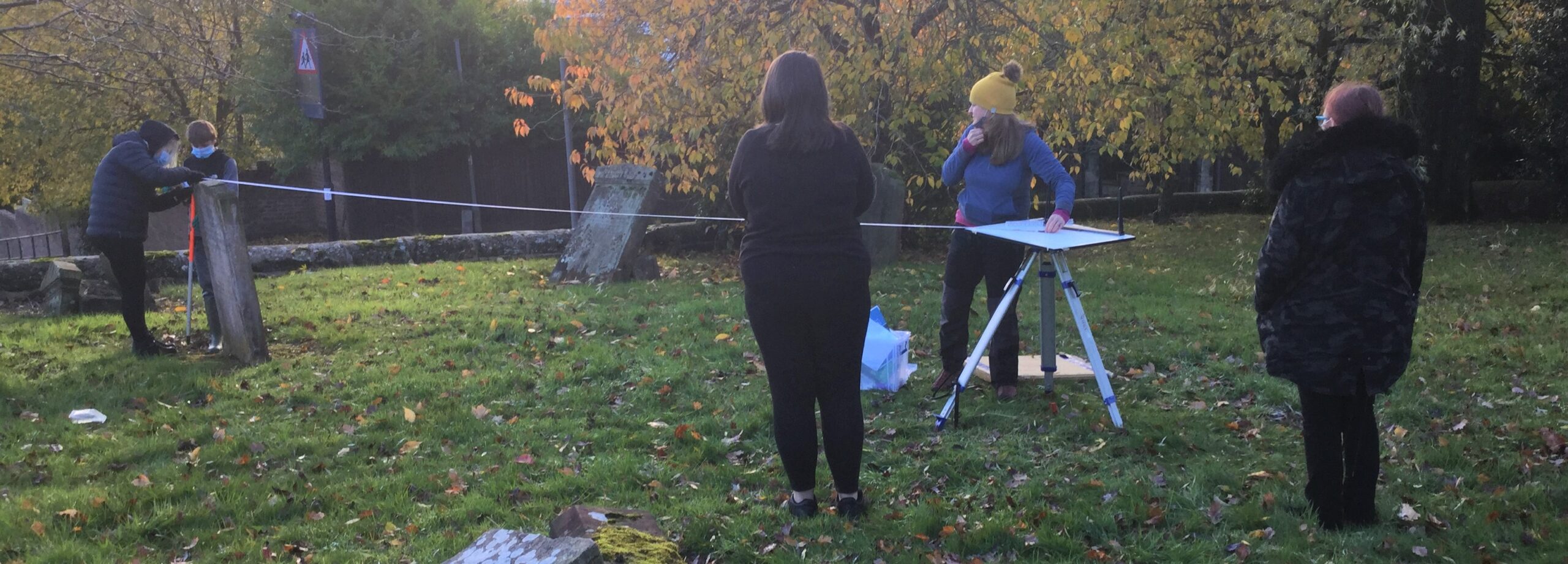
Plane Table Survey
Following the desk-based assessment of the site, a plane table survey was conducted in order to more accurately record a selection of the visible upstanding remains present. All work was undertaken according to CIfA standards and guidance (CIfA, 2014f).
Heritage Interpretation
The students designed interpretation panels to share their findings about the history of the cemetery and to reflect on the skills they’d acquired.
Learning Outcomes and Skills
By engaging with this project participants:
- gained an understanding of archaeology and how archaeologists study the human past
- learned that we can find out about the past by looking at different types of evidence, historical and archaeological
- were able to interpret different types of historical and archaeological evidence
- understand the principles of archaeological excavation, building recording and gravestone recording and why they are important
- gained the skills required to complete gravestone recording and building recording tasks.
- have gained new knowledge and understanding of their local area, its history and archaeology.
Participants also developed a number of transferable workplace skills:
- Timekeeping- completing tasks on time
- Completing a task when asked
- Problem Solving – participants are able to consider and discuss why we are finding particular features and artefacts
- Good observational skills – noticing changes in features and soil types and using communication skills to discuss what these changes tell us
- An understanding of health and safety issues – site and tools/equipment
- Working individually and as a team to complete tasks