Lets Get to Know: Audrey Shore Henshall (1927-2021)
Our Work and Henshall’s Legacy
Following a generous bequest from the late Audrey Henshall OBE HonFSAScot, the Society of Antiquaries of Scotland has awarded funds to Archaeology Scotland for a new initiative titled Scotland’s Earliest Megalithic Monuments. The project was officially announced during the Society’s anniversary meeting held in Edinburgh on 30 November 2024.
Our Adopt a Monument Team will be leading investigations into some of these ancient sites, together with local communities, with the aim of providing further insight in to these internationally important monuments and continuing on the great work of Audrey Henshall.
Dr Gavin MacGregor FSAScot, Director at Archaeology Scotland, said:
“Archaeology Scotland are exceptionally grateful to the Society of Antiquaries of Scotland for supporting the Scotland’s Earliest Megalithic Monuments project through their Audrey Henshall Legacy Fund. This grant will allow us to support more communities to learn about and care for Scotland’s monuments, building on our existing Adopt-a-Monument scheme. The results of our investigations will enable us to more widely tell stories of those who built them and together celebrate the pioneering work which Audrey championed to advance their study.”
More About Audrey Shore Henshall
Audrey Shore Henshall was a key figure in Scottish archaeology, celebrated and well known for her meticulous work on prehistoric burials and neolithic chambered tombs. Henshall was one of Scotland’s first professional female archaeologists and made a significant contribution to Scottish Archaeology during her impressive career.
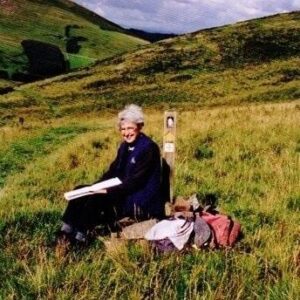
Audrey Henshall photograph © Rosemary A Meldrum
Born in Lancashire in 1927, Henshall moved to Scotland after leaving school, travelling to Edinburgh to begin studying archaeology at the University of Edinburgh under the tutelage of Stuart Piggot. She graduated with her MA in 1949 and was appointed a research fellow in the Department of Archaeology.
Encouraged by Piggot, she turned her focus to Neolithic burial monuments and, by 1951, had embarked on her groundbreaking research into Scottish chambered cairns.
In 1952 Henshall began her career at the National Museum of Antiquities of Scotland (now known as the National Museum of Scotland) as Assistant Curator.
From 1960 to 1971 she was the Assistant Keeper of Archaeology a the National Museum of Antiquities.
In 1970, she was appointed Assistant Secretary of the Society of Antiquaries of Scotland and was later made an Honorary Fellow of the Society. She was also elected a Fellow of the Society of Antiquaries of London.
In addition to her work on chambered cairns, she carried out extensive research on early textiles. Her findings were widely published in professional journals during the 1950s and 1960s. Among her most notable work was the analysis of the Gunnister Man’s 300-year-old clothing—remarkably preserved in a peat bog in Shetland—which drew significant interest. She also identified the colours used in centuries-old woven fabrics, and her discovery of a tartan pattern at Dungiven in Ulster played a key role in the revival of an early 17th-century tartan design.
Neolithic pottery was another important area of her meticulous research. Often recovered from both cairn sites and settlements, the pottery fragments she studied were documented with detailed descriptions and precise drawings. Her work laid vital groundwork for the classification and understanding of Scottish Neolithic ceramics.
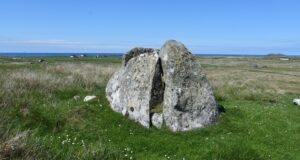
Image by Dr Gavin MacGregor, Director of Archaeology Scotland
She conducted surveys of monumental sites throughout Scotland, resulting in two volumes of The Chambered Tombs of Scotland (1963, 1972), and co-authored an additional four volumes focusing on regional groups of monuments. Beyond this, she published significant studies on Scottish prehistoric artefacts—including Bronze Age daggers, pottery, and jet necklaces—and maintained a strong interest in prehistoric textiles. Her meticulous documentation and insightful interpretations of Scotland’s megalithic monuments remain invaluable to the field today.
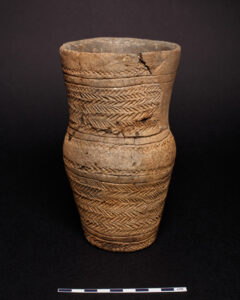
Beaker pottery from Seafield West, Inverness (Inverness Museum and Art Gallery). ©Michael Sharpe