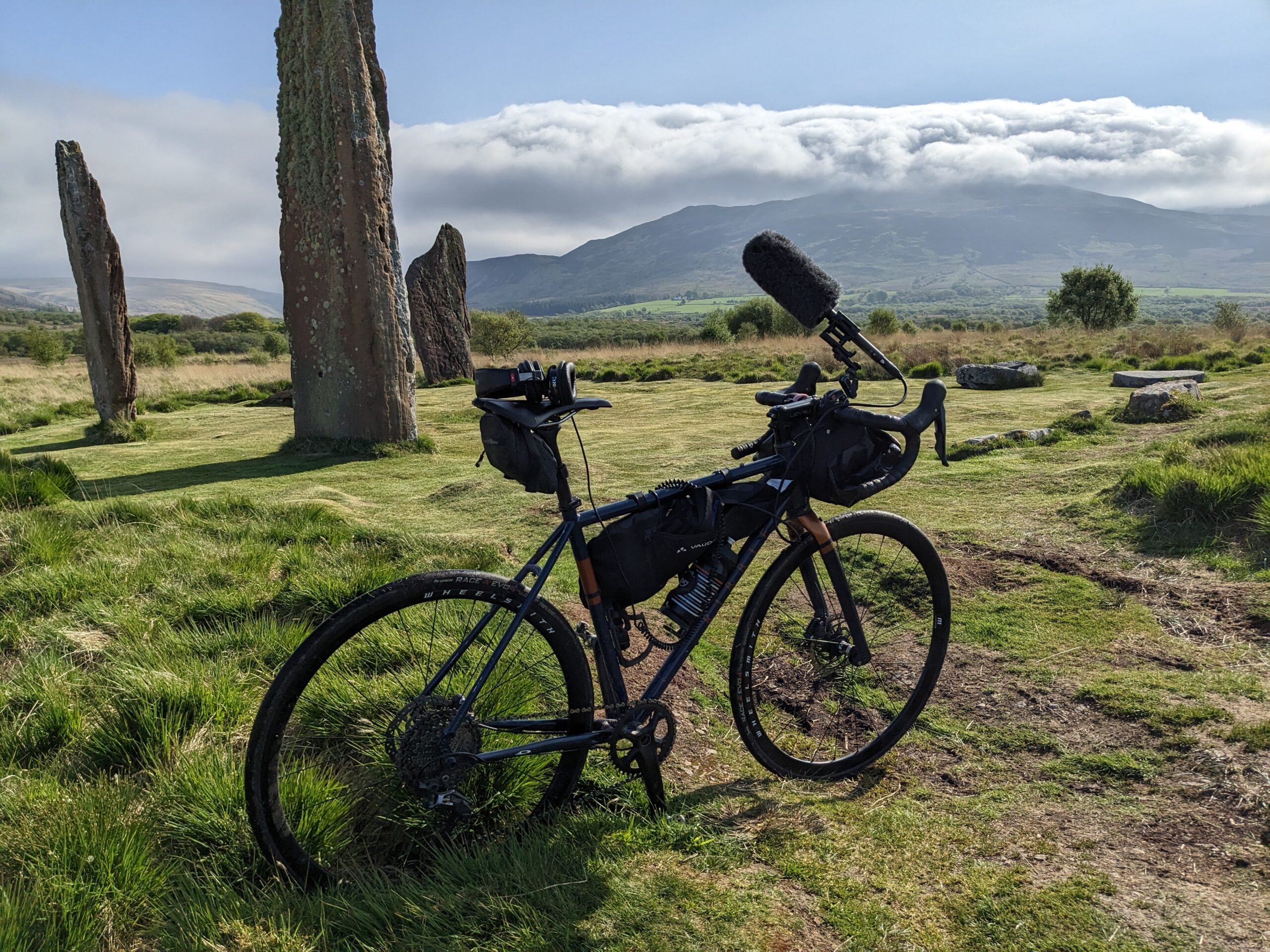
If you were to visit Scotland’s most exciting Neolithic sites, how would you choose to travel? My guess is probably not by bike, and probably not in the spring, when the weather is depressingly unpredictable.
So how did I find myself with a fully loaded bike, struggling through Hebridean winds to the Stones of Calanais, four long days in the saddle behind me?
It was all for my new podcast, Stone Me, in which I travel by bike, boat and train to seven of the most interesting, exciting and beautiful neolithic sites. I’m just an interested person, not an archaeologist. But I had always wondered about the standing stones or stone circles I passed on a cycle or a walk: who put those there? What were they used for? What did they mean?
So I got on my bike to find out, packing recording gear and clothes, booking trains and ferries and getting my rain gear ready for the journeys.

Orkney opens my eyes
A short holiday to Orkney had opened my eyes to the incredible sophistication of Neolithic society. I just found it hard to believe that these people, the very first to settle and farm and give up nomadic life, created such rich culture, travelled so far, and had a shared sense of belonging and spirituality over such an astonishingly wide area.
I wanted to find out for myself, to touch the stones and get a sense of the special places these monuments occupied. And I had help: experts in each site agreed to meet me there and tell me the stories of the stones.

The sophistication was incredible
So I learned about the cultural melting pot of Kilmartin Glen where Irish passage tomb styles mixed with Atlantic and Orkney styles in the incredible rock art which is unparalleled anywhere in Britain.
I learned about the lunar lightshow that happens every 18.6 years at Calanais and the geographical features that may have dictated why that glamorous, beautiful site was built exactly there.
I found out about the incredible 4,000 years of worship, ceremony and ritual that took place on a hilltop outside Bathgate at Cairnpapple Hill. There cannot be many places in Europe where human worship and ritual happened for four millennia.

Do we have a stone bias?
I also found out about all the things we can no longer see – the amazing wood-building traditions of Neolithic people, such as the timber circle that predated the stone one at Circle 1 at Machrie Moor. We think the stones are the central structures of Neolithic life because we can still see them, but the wood and earth ones must have been just as impressive and important.
I learned about the incredible diligence, care and skill of the archaeologists when, often once in a generation at best, they get the chance to dig at these iconic sites. More than once, the experts took out dig reports that were decades old to explain what was going on. Without the meticulous attention to detail of those older archaeologists, experts of today would have little chance of understanding what secrets lie under the ground.
It has been a privilege to visit these ancient, sacred places and spend time with the people who understand them best. And if it took a bit of hard pedalling into the wind along the way, it seems a small price to pay.
The sites and experts that will feature in Stone Me
The Ness of Brodgar, with site director Nick Card of the University of the Highlands and Islands (UHI)
Calanais Stones with archaeologist Ian McHardy
Kilmartin Glen with Alison Sheridan, Research Associate at National Museums Scotland.
Ring of Brodgar with Jane Downes, Director of the UHI Archaeology Institute
Machrie Moor with Kenny Brophy, Senior Lecturer, archaeology, Glasgow University
Cairn Papple with Alison Sheridan, Research Associate at National Museums Scotland.
Sighthill, Glasgow, with site creator Duncan Lunan and Kenny Brophy, Senior Lecturer, archaeology, Glasgow University.
Stone Me, Investigating Scotland’s Oldest Places is available wherever you get your podcasts and at www.stonemepodcast.com
All photographs featured in this blog are the copyrighted property of Matthew Magee
Article by Matthew Magee | Stone Me Podcast
July 2023
Follow the Stone Me podcast on social media: