Professor Hannah Cobb on Audrey Henshall
“Shells have been found in rabbit scrapes in the cairn” – Audrey Henshall describing Cladh Aindreis, 1972
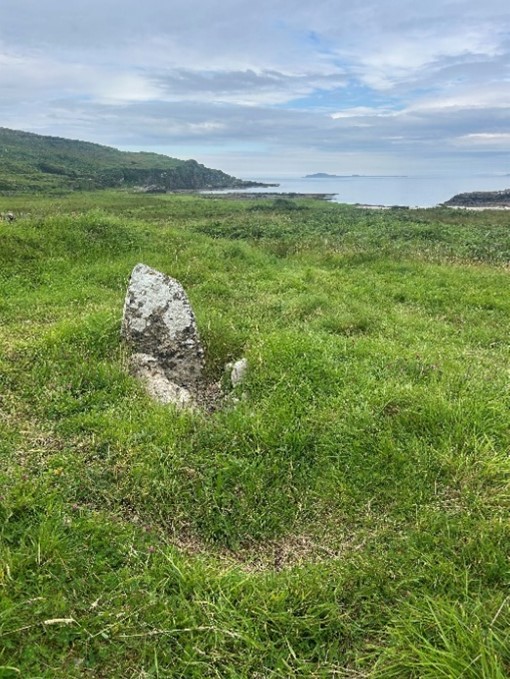
Cladh Aindreis in July 2025
Picking out Cladh Aindreis from the road isn’t easy even when you know where to look. The monument is covered by a sprawl of bracken which turns into rough undulating grass cover around the central area. We pass through two gates and cross a small wooden bridge over the burn, navigating nettles and brambles as we go. Thankfully it is overcast and threatening rain so there was no temptation for short sleeves. Cladh Aindries (ARG 1) was the first entry in Henshall’s (1972) catalogue of sites for her second volume of The Chambered Tombs of Scotland. The first focused on the northeastern mainland and Orkney and Shetland, while the second covers the rest of Scotland including entries from Argyll, Ayrshire and the Western Isles. It seems a very fitting place to begin exploring the legacy of her work. My last blog post saw us arrive in Ardnamurchan and introduce this site that sits at the heart of the Ardnamurchan Transitions Project. This time we will explore this legacy further.
Leading the way through to the site is Hannah Cobb. Hannah is a Professor of Archaeology and Pedagogy at the University of Manchester. She is a co-director of the Ardnamurchan Transitions Project (ATP), which has trained hundreds of students in archaeological practice in Ardnamurchan since 2006. She kindly agreed to chat to me this morning about the history of her involvement in archaeology in Ardnamurchan, the legacy of Audrey Henshall in the Neolithic archaeology of the area and her hopes for the future of access and inclusion within archaeology.
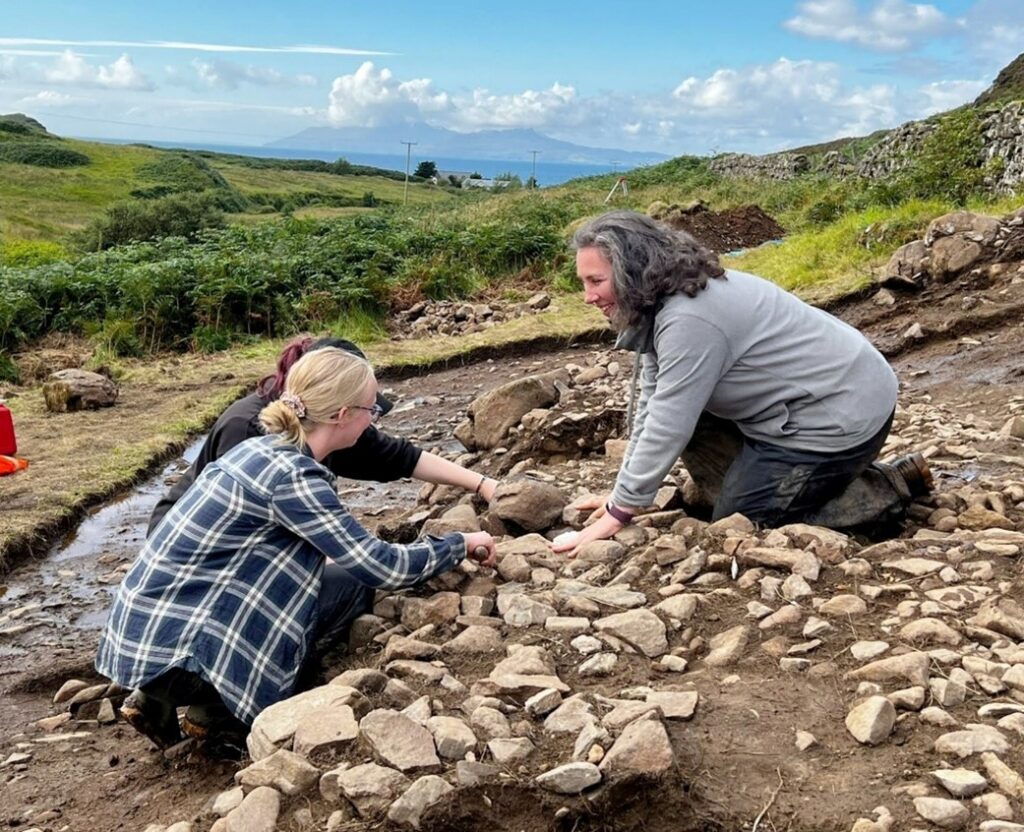
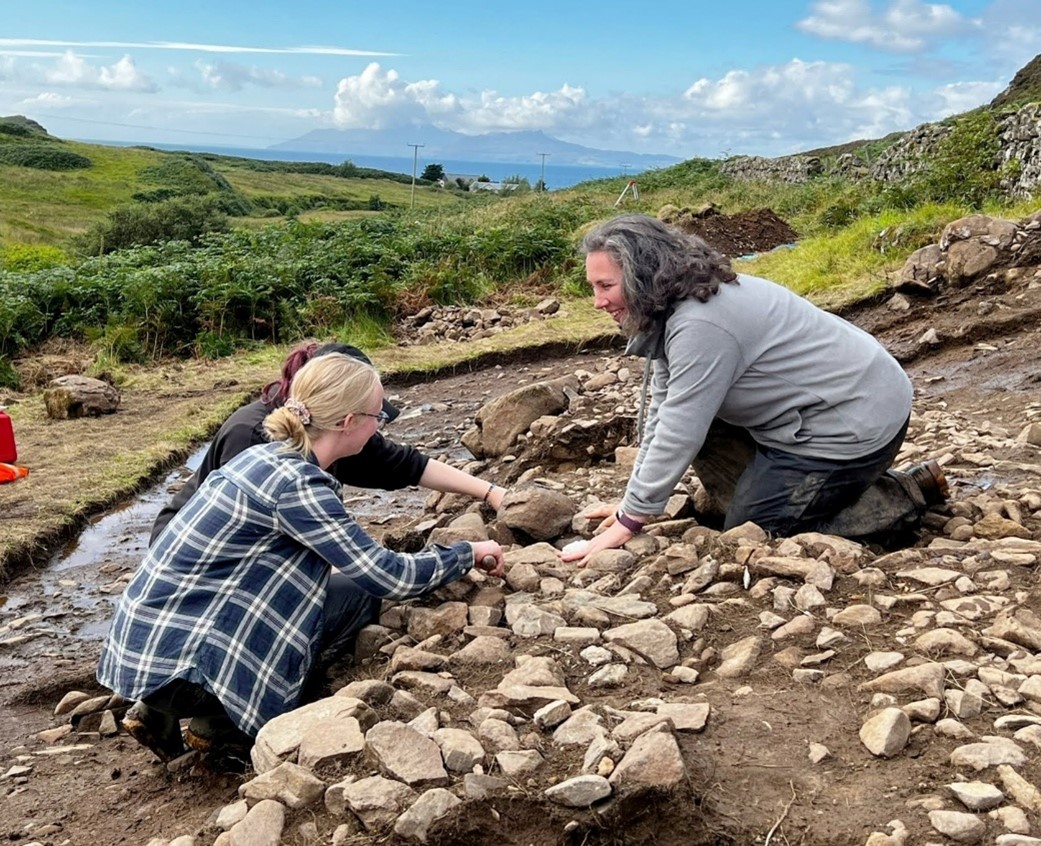
Hannah Cobb (right) at work in Ardnamurchan (Courtesy of Hannah Cobb)
We’ve chatted on the walk over but now we are standing within the area of the monument, we pause and take it all in. This is my second visit and Hannah has been countless times, but it has the same impact, and within a week of running a busy field school lets us take a breath in a little pocket of peace. I wonder if this has been true for everyone who has interacted with this site, or if it has been filled with just as many points in the past where this landscape has been alive with activity? The original builders of this monument were farmers, hunters and foragers; skilled crafts-people, toolmakers and storytellers. The span of time between when these people lived and the Roman presence in Britain is larger than between the Romans and the present day. For me this is mind boggling, and I frequently remind myself how different Neolithic people’s worlds were to my own, but then some of my feelings about the atmosphere of this place seem so timeless.
Hannah shares her first impressions of Cladh Aindreis from when she first visited the site in 2004. “I didn’t know how to get into the bay. My dad was driving me because I couldn’t drive at the time…we drove too far and came over that hill”, she points to the top of the slope behind the monument and we laugh. They really were lost! But this vantage point must have offered a stunning view of Swordle Bay. “We stood on the top of the hill and we looked down on the Bay…and my Dad said “Wow this is a magical place isn’t it?” And I absolutely agreed, it really is”. This visit was part of Hannah’s MPhil research while studying at the University of Manchester. In her search for sites she had consulted Audrey Henshall’s work, pouring through records of Neolithic tombs. Among these entries she noted Henshall’s description of rabbit holes with shells sitting inside them within the area of Cladh Aindreis, potentially indicating that the site was a Neolithic chambered tomb sitting on top of a Mesolithic shell midden, a topic many researchers were interested in at the time. On her return to Manchester, Hannah met Phil Richardson for a coffee. “We were talking passionately about sites with potential to have both Mesolithic and Neolithic evidence present we were like, we should go and find out more!” Even discussing these events over 20 years later, Hannah’s excitement is infectious, and this sense of possibility is still in the air. “It’s one little line and that’s the reason we are here 19 years later as a result of one line that Audrey Henshall wrote”, Hannah says.
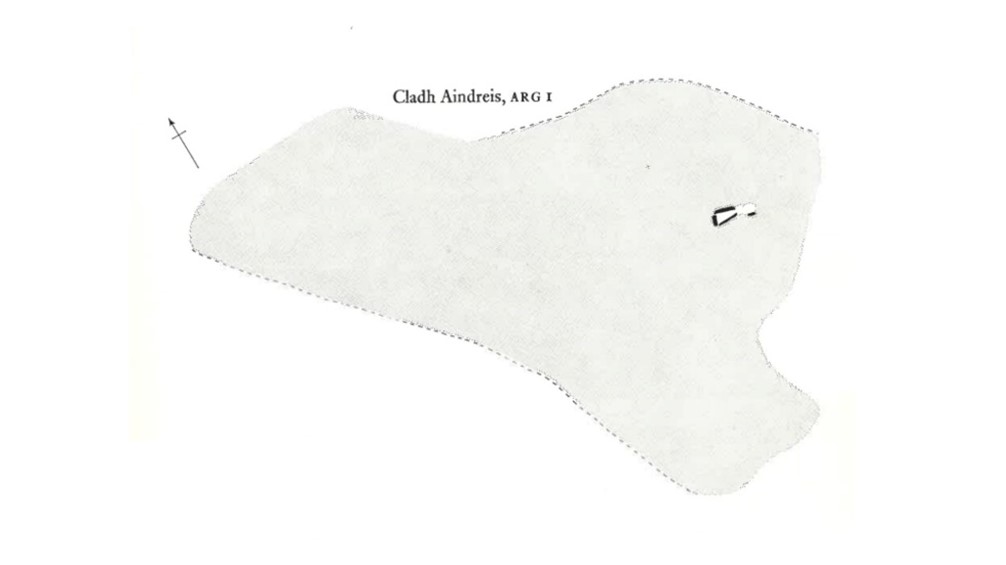
A plan of the site (from Henshall 1972, 317)
Hannah’s admiration for Henshall’s work, not just in terms of the archaeological recording, is clear as our conversation turns to the practicalities of surveying. We both obsess a little over clothing choices, and how you could possibly dry out while conducting several days surveying in a Scottish Autumn. Did she stay in a local hotel? Did she camp? We look around the site and try to adjust ourselves in time, both seasonally and casting back to Ardnamurchan in the early 1960s. We think that the bracken must have been down for her to spot the edge of the monument, not currently visible in a lush green July. Hannah tells me that the ATP and the Ardnamurchan Estate paid for the bridge to be built to save wading over the river or cutting across the mouth at low tide. These may seem trivial questions but as Hannah puts it “This project is about 70 or 80 percent dealing with all the practicalities of being in such an isolated place and training people and doing the right thing by the archaeology, and probably only about 20% digging. And that balance of logistics vs archaeological investigation must have been the same, if not more, for Audrey Henshall.”
We also discussed the specific experience of conducting archaeological fieldwork as a woman, and of issues relating to gender in the field more broadly. While a lot has changed since Audrey Henshall was surveying in the 1960s, structural inequalities remain. I ask Hannah, from her experience, if there is anything that seems to be a consistent issue in terms of gender equality in archaeology. “I think that people are still having to make those choices about whether and when to have children and how to balance other care responsibilities, which often fall to women. When and how can I continue doing this job that I love and have the sort of things that I want to have?” Hannah herself has three children, and while now she is able to leave home for a two week fieldwork project without too much difficulty, this was not always the case. While Hannah’s husband, and her ATP co-directors Phil and Ollie, were all supportive and happily adapted, time away from projects for maternity leave or care responsibilities is a real concern. Importantly for Hannah, “nobody has said…you’ve been gone off the project for one year and your voice is now not valid.” In fact, the team have drawn upon the various experiences of care beyond and within the project to create positive change and build a deliberately inclusive stance. “Because we’ve been working for 19 years here, and together, it’s given us the space to confront structural inequities and we’ve worked them through and been clear that we don’t want to be part of those! We don’t want to do that. If it was a shorter project you don’t have the space for the kind of introspection and the learning from that.”
This learning is very apparent in the atmosphere of the ATP fieldschool. Students are encouraged to share their thoughts and opinions on the site as work progresses; it is clear that their voices are valued as well as their ability to shift soil. Archaeology may be what has brought everyone here, but people come first. Giving students opportunities not only to learn archaeological skills, but to decompress, socialise and to think more broadly about their careers and options after university. As many former students return to the dig, either as volunteers or staff, this means that a variety of personal experiences are available to be shared with the next generation of students. Some go on to pursue academia, others to commercial archaeology, while others move to careers in other fields like teaching. What I am seeing is just the current configuration of a huge network of people, all with this place in common.
Although Audrey Henshall was the catalyst, the credit for this legacy must also sit with the ATP team. I ask Hannah what she would like her own legacy to be. If we were to return here in another 60 years to consider the legacies of the next generation of archaeologists in the region, how would she like her work to be discussed? “I think that I probably haven’t done enough yet to have had an adequate legacy. I think everything up to this point is like a really important sort of foundation layer. What I’d really like to see is the statistics from the profile of the profession just continue to change and change… I’d like to be part of changing the structures that make that difference, in which case then my legacy will probably not be visibly attached to me be about just the kind of structural change that archaeology needs to make it more inclusive.” These structural changes refer not only to improving access to and attitudes within the field of archaeology for women and non-binary people, but also for people who are, for example, non-white, working class and/or disabled. There is a long way to go before our profession is representative of the broader population and with so many voices missing, the stories we are able to construct about our past are lacking valuable knowledge, experience and diversity.
Finally, I ask Hannah if she has any advice for new archaeologists entering the field, particularly for women, non-binary people and for those who are currently a marginalised voice within the profession. “I think there’s something about being tenacious and not giving up” she says, but also recognises the importance of other people are able to lift you up. She highlights our tendency to individualise success, particularly when it comes to archaeological research: “in many ways [individual legacies are] a falsehood – archaeology is always a collective endeavour – so perhaps the best advice is to lean into this and be part of a community of people who you can work with in equity…because then you’ve always got people who can share the load or take the steering wheel when you need to step away or who can raise you up and you’ve got that kind of ready-made network….I think that’s probably the best bit of advice: forging communities of practice and care through which you can proceed.”
The work of Audrey Henshall at Cladh Aindreis has created ripples that have continued to spark the interest of archaeologists decades later. Her work directly lead people like Hannah and Phil back to Ardnamurchan, who in turn continue to bring more people into this community of archaeologists connected to the heritage of this place. In our next blog post I will be drawing on the ATP network even further as I chat to Hannah again, this time alongside two people who have become involved in archaeology here as a result of the work of the Ardnamurchan Transitions Project and Archaeology Scotland.
For more information:
Ardnamurchan History and Heritage Association: www. heritageardnamurchan.co.uk
Supported by the Society of Antiquaries of Scotland’s Audrey Henshall Legacy Award.