
In 2022 Archaeology Scotland’s Adopt-a-Monument team headed out to the West Coast of Scotland to conduct test-pitting with volunteers from the Stronafian Heritage Project (SHiP) at a site called Creag Liath (or Grey Stones) close to Glendaruel to determine whether it’s cell-like features were archaeological in nature. The site sits in the shadow of Auchategan, a multi-phase settlement excavated in the late 1960s by Dorothy Marshall that uncovered a hut circle complex, stone house, bloomery, post-hole hut, Bronze Age cairn and cists and two Neolithic domestic layers – all within a depth of 1.2 metres! At Creag Liath sufficient evidence was found to suggest human occupation so a plan was formulated with the Stronafian Community Forest and Colintraive & Glendaruel Development Trust to return.

Upright Stone in Trench 1
Fast forward to 2023 and an intrepid team of local volunteers joined Archaeology Scotland for 12 days of excavation from 25th September to 6th October. The dig began by re-opening and extending Trench 1 which had previously been located over a possible stone wall, this time marking out four quadrants of the cell whilst leaving a baulk to aid with stratigraphic analysis. Trench 1 also featured an upright stone of considerable size and its presence and function triggered much debate over the course of the dig.
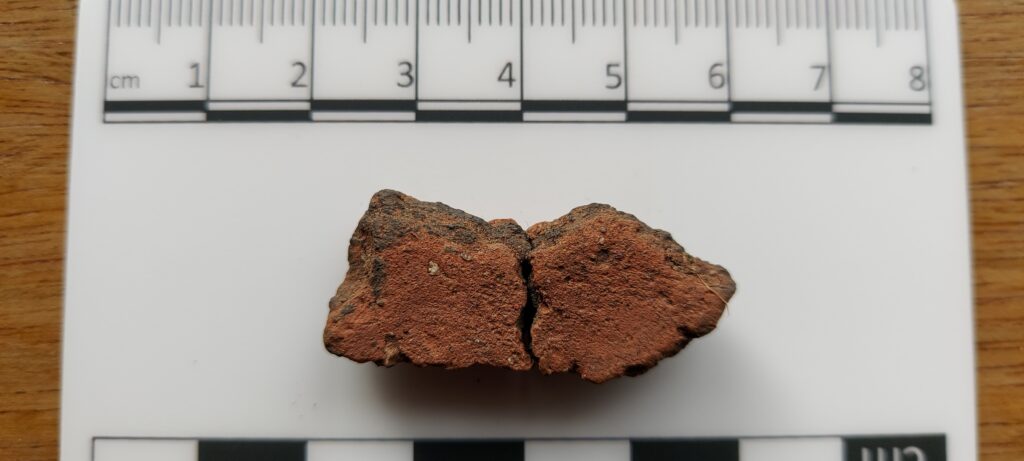
Prehistoric Pottery
On just the second day of digging our eagle-eyed volunteers started to find pottery. The most exciting was two small sherds of reddish-brown gritty ware, identified as a rim and believed to be either Bronze Age or Neolithic in date. Further analysis needs to be conducted on the sherds to provide a clearer provenance. The same day a sherd of post-medieval pottery was located followed by broken bottle glass. These were exciting finds and fantastic evidence of the people who once frequented the site.
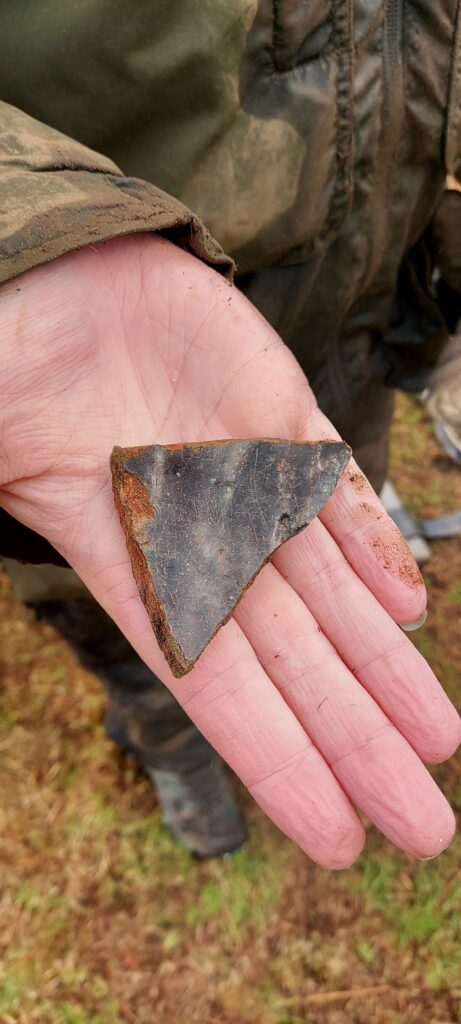
Post-medieval pottery
As the dig progressed it was clear that we had a substantial wall, approximately 1 metre in width, forming the footprint of a structure that was sub-rectangular in shape. Finding the internal turn of the wall was one of those Eureka moments. How the wall related to the next cell became the new challenge. Were the second and third cells contemporary with the first or did they represent a different phase of construction? Questions that further excavation will hopefully answer.
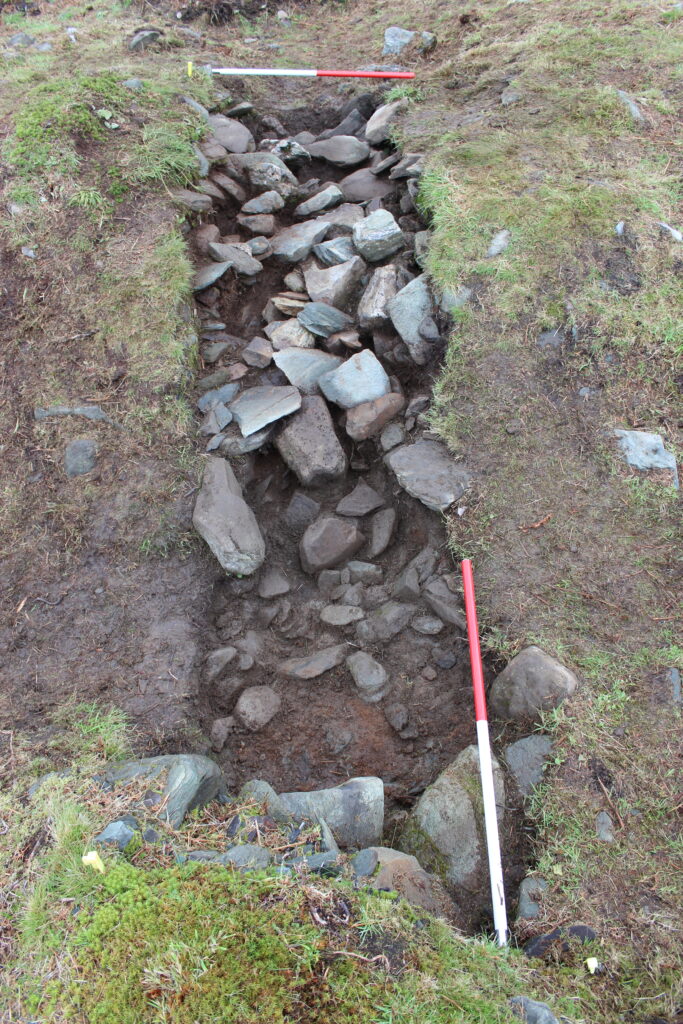
Trench 2 – facing north
Trench 2, opened in 2022, was re-opened and excavation continued to determine if a stone wall formed the boundary of this cell and whether a break in the stone bank was evidence of a threshold or entrance. A new trench, Trench 3, was located over a potential sunken path leading to the entrance of the main structure and by the end of the dig this had started to reveal some intriguing contexts.
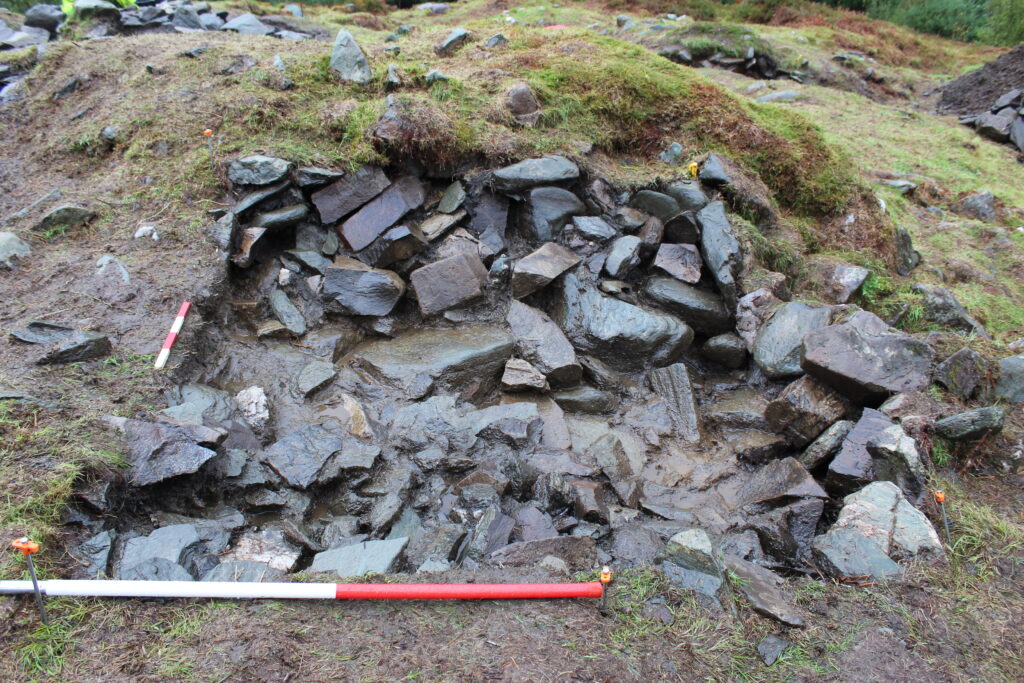
Trench 2 – facing west
We would like to thank all of the wonderful volunteers who dug with us over the 12 days. Twenty-five people volunteered over 60 days which is an amazing feat, especially as the team experienced some challenging weather conditions. It was also great to invite over 40 schoolchildren from Kilmodan Primary, Strachur Primary and Dunoon Grammar to be young archaeologists for the day and dig with us. We also ran an artefact handling workshop at Kilmodan Primary School and hosted an Open Day on site as part of Scottish Archaeology Month.
Here’s to what the next chapter in the story may bring!
Article by Andrew Jepson | Archaeology Scotland
October 2023
Archaeology Scotland and Stronafian Community Forest are grateful to CRUACH MHOR WIND FARM TRUST and HES for funding the CGDT Archaeology Group’s excavations at Creag Liath.