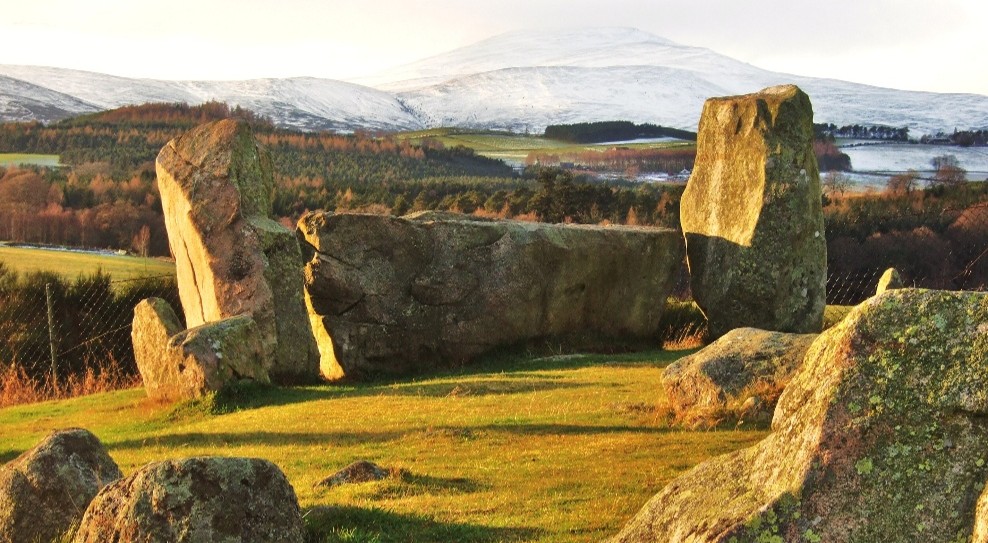
The transition from the Late Neolithic to the Early Bronze Age in Britain and Ireland has often been framed through narratives of migration and population replacement, particularly following archaeogenetic studies demonstrating substantial demographic turnover around 2500 BC (Olalde 2018; Booth & Bruck 2021; Parker Pearson et al 2019). While these developments have significantly reshaped understandings of prehistoric mobility, explanations centred primarily on genetics risk reducing cultural change to a biological process.
Increasingly, research has demonstrated that migration alone cannot explain the diversity of archaeological evidence. Rather than representing a uniform cultural package, practices associated with the Beaker phenomenon appear to have been adopted selectively, varying considerably between regions and communities. Monument traditions, settlement patterns, and material practices also suggest significant continuity alongside change, challenging interpretations based on abrupt cultural rupture.
This raises a broader question: how did communities themselves engage with and interpret these transformations? Rather than viewing the Early Bronze Age as a clear break from the Neolithic, this study explores how communities actively negotiated identity through their interactions with ancestral landscapes, monuments, and material traditions. Change, in this context, was not simply experienced; it was actively shaped through everyday material practices and social choices.
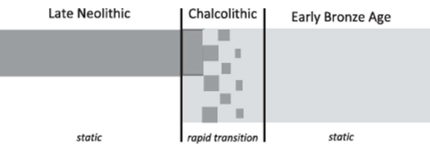
The image shows a model by Crellin 2020: chapter 8 showing the transition from the Neolithic to the Early Bronze Age, this study focussed on the rapid transition period and the following static period of the Early Bronze Age.
Introduction to the model
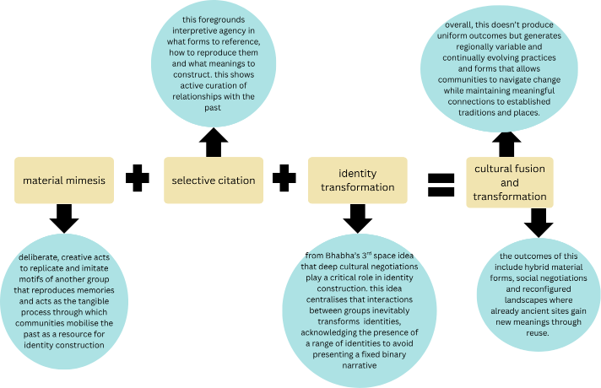
The Agent-Centred Cultural Fusion (ACCF) model was developed to address a gap in existing interpretations of the Late Neolithic–Early Bronze Age transition. The ACCF model instead centres communities as interpretive agents, recognising cultural change as something actively negotiated rather than passively experienced. ACCF instead places human agency at the centre of interpretation, viewing communities as deliberate actors who negotiated identity within changing social landscapes.
The model operates through three interconnected mechanisms: material mimesis, selective citation, and identity transformation through fusion. Material mimesis examines how communities reproduced and adapted existing forms; selective citation focuses on the choices people made about which elements of the past to retain or reference; and identity transformation explores how these interactions created new identities rather than preserving fixed cultural boundaries. Together, these processes provide a framework for understanding cultural change as negotiated, regional, and dynamic rather than passive or uniform. The image below shows this mechanism.
Results
Across Scotland, the transition from the Neolithic to the Bronze Age was not a clean break but a gradual and purposeful renegotiation with the past. Rather than abandoning the sacred places of their predecessors, Bronze Age communities returned to them, modified them, and invested them with renewed meaning layering new beliefs onto landscapes already dense with ancestral significance.
Nowhere is this process more vividly apparent than in Kilmartin Glen, Argyll, one of the most important concentrations of prehistoric remains in Scotland, where Neolithic and Bronze Age ceremonial and burial monuments cluster together in places that were in use and reworked for many centuries (ScARF, 2012). Temple Wood stone circle exemplifies this long-term engagement. The monument’s earliest phase belongs firmly to the Neolithic, yet construction and modification continued across the transitional period, with the final setting of the stones representing the culminating act of a sustained communal endeavour stretching into the Bronze Age (Evans and Dowson, 2005: 105). By around 2000 BC, the site had become the focus of funerary activity, with the construction of small burial cairns alongside the stone circle, demonstrating how Bronze Age communities actively incorporated older structures into their own ceremonial worlds (Historic Environment Scotland, 2024).
The treatment of rock art across the wider Kilmartin landscape reveals an equally deliberate engagement with Neolithic heritage. Elaborate carved panels were allowed to remain visible across the open landscape, retaining their public potency, while the art applied to cist slabs was kept intentionally simple the more complex imagery left to speak to the living rather than being enclosed with the dead (Evans and Dowson, 2005: 105). This selective approach points to a nuanced understanding of how inherited symbols could be distributed across space to serve both the ancestral and the funerary.
In north-east Scotland, the recumbent stone circle tradition offers further evidence of this continuity. At Tomnaverie, radiocarbon dates span approximately 2500 to 1050 BC, and while the erection of the stones marked the end of physical monument construction, human activity at the site persisted well beyond this point (Bradley, 2005: 48–49). Cremation burials dating to the Middle and Late Bronze Age were inserted at Tomnaverie, reflecting the enduring reverence for a place already ancient to those who continued to use it (ScARF, 2012).
Collectively, these sites demonstrate that Bronze Age communities across Scotland did not regard Neolithic landscapes as obsolete. They were living inheritances – to be returned to, reinterpreted, and kept meaningful across generations.
Key conclusions
Bronze Age communities across Ireland, Scotland, and Wessex display a consistent pattern of deliberate engagement with Neolithic landscapes and material traditions. Rather than supporting straightforward replacement narratives, the evidence suggests that communities actively negotiated relationships with the past, using monuments, architecture, and material culture as tools for constructing identity. Through the ACCF framework, this extended temporal engagement represents more than simple continuity, it constitutes active memory work where each successive deposition and modification functioned as an act of selective citation, reproducing relationships with ancestral landscapes.
This continued engagement with ancient sites likely fulfilled several interconnected social functions. First, it provided a degree of ideological continuity during periods of demographic and cultural transformation, allowing emerging practices and identities to be framed as developments within an existing social framework rather than as abrupt ruptures with the past. In doing so, these engagements may have helped mediate the tensions that can accompany new technologies, practices, and populations. Second, the deliberate juxtaposition of older and newer forms of monumentality created material dialogues between past and present. For incoming or newly forming communities, engagement with ancestral places may have acted as a means of establishing legitimacy and belonging, while for established groups it reinforced long-standing relationships with the landscape and its histories. Finally, repeated acts of construction, deposition, and reuse transformed these locations into places of accumulated significance. Each successive interaction layered new meanings onto already ancient places, increasing their symbolic weight and ensuring their continued importance within evolving ceremonial and social worlds.
Monument reuse provides some of the clearest evidence for this. Sites such as Raigmore, Temple Wood, and recumbent stone circles were not simply abandoned relics of an earlier age but continued to attract activity across long periods of time. Repeated acts of deposition, rebuilding, and modification suggest that these places accumulated significance through continued engagement. Their importance may therefore have rested not only in their original function, but in the fact that they had already become ancient. Returning to these locations created visible links between present communities and ancestral landscapes, embedding memory within the material world.
At the same time, the evidence demonstrates that these relationships with the past were highly selective. Communities did not preserve Neolithic traditions unchanged, nor did they adopt all new practices uniformly. In Ireland, for example, Beaker-associated practices appear to have been selectively incorporated into existing traditions rather than replacing them entirely. Similar patterns emerge in the use of rock art and architecture, where communities repeatedly chose which elements of the past to reproduce and which to leave in the landscape untouched. Such decisions suggest that engagement with earlier traditions involved active interpretation rather than simple inheritance.
Regional differences are particularly important here. Although broad patterns of continuity can be identified across Britain and Ireland, the ways communities engaged with monuments and material culture varied significantly between regions. This variation challenges large-scale explanations that rely solely on migration or diffusion and instead highlights the importance of local histories and social circumstances.
Taken together, the evidence suggests that cultural change during the Late Neolithic–Early Bronze Age transition was not a process of straightforward replacement but one of ongoing negotiation. Communities actively used material practices to shape relationships with the past, creating identities that balanced continuity with innovation within increasingly interconnected social worlds.
Overall, this study demonstrates that monument reuse, architectural hybridisation, rock art citation, and material culture functioned as interconnected strategies through which Bronze Age communities actively negotiated relationships with Neolithic pasts while constructing new identities. Rather than reflecting passive continuity or straightforward replacement, these practices reveal communities making deliberate choices about memory, ancestry, and belonging. The ACCF model provides a framework for understanding these interactions as processes of material mimesis, selective citation, and identity transformation. Cultural change therefore emerged through dynamic and locally specific negotiations, where identity was actively performed through material practices rather than determined solely by descent.
By Grace Webster, MA Archaeology, Gracewebster24@gmail.com