
On a hot, sunny day at the start of August, staff from Archaeology Scotland, students and local participants joined forces to break ground on our Big Dig. Over the next 8 days, over 130 people of all ages and backgrounds took part in the excavation, recording and interpretation of the fascinating archaeology that lay in wait under all of that turf. Measuring 10 metres long and 8 metres wide, this Big Dig was no small feat!
Over 130 participants of all ages and backgrounds took part in the excavation over 8 days, some of whom returned day after day. Participants included members of local communities, students and groups such as Edinburgh Young Carers, a Multiply adult numeracy group and a group of New Scots from our New Audiences ESOL project in Dundee.

Troweling the top soil in the sunshine.
The Big Dig site was open to the public, in the beautiful grounds of Newbattle Abbey College, whose archaeological evidence dates back to prehistory! We spoke to hundreds of passers-by, with many returning each day to follow our progress and some returning to dig. By sharing their local knowledge and family stories, they really brought the past to life, and provided a deeper understanding of the site. This was the perfect location to bring together the physical, tangible archaeology that participants unearthed (more about that below!) along with the invaluable conversations, community connections and personal histories of local people.
“It’s nice seeing how many different people between the ages, qualifications, life experience can be involved in the same project and have the same mindset going into it and coming away from it…some of the younger ones on the open day, they were running around shouting ‘I want to be an archaeologist!”. (Student)
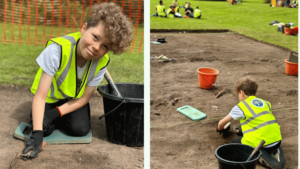
Participants of all ages took part in the Big Dig.
Our Big Dig had big aims:
- To see if we could find, characterise and record what our research (called a Desk Based Assessment) suggested was a practice trench from the Second World War period.
- Encourage and empower local community participants and passers-by to enjoy, connect with and care about the past, place and archaeology (as well as their personal and local heritage).
- Support students to gain archaeology skills and understanding.
- Develop and strengthen Numeracy and STEM (Science, Technology, Engineering and Maths) skills using archaeology and activities inspired by Newbattle Abbey College’s Second World War heritage.
What did we hope to find?
Newbattle Abbey College has a rich and fascinating past spanning thousands of years. You can read our earlier Blog to learn more.
The focus of the Big Dig 2024 was to use archaeological excavation to explore whether we could locate and characterise a Second World War practice trench situated to the north-east of the main college building. The feature had been identified as shallow depressions in the ground, and a reference in the national record of the historic environment provided grid references for both ends of the trench, but no trace could be seen from recent aerial photography.
However, an aerial photograph of Dalkeith taken by the RAF in 1946 revealed an intriguing feature at the same location; a line turning at right angles in a ‘crenellating’ pattern. Modern-day LiDAR (technology which uses lasers from above to map features on the ground remotely) also confirmed the crenellating shape and orientation of the feature.
Despite these compelling references to a practice trench, there were no known documents, maps or oral reminiscences recalling who dug or trained at any trench at Newbattle Abbey College during the Second World War.
It was therefore hoped that an archaeological excavation would be able to confirm the existence of the practice trench and its state of preservation, as well as providing an opportunity to learn more about the people who interacted with the trench during the Second World War through the potential discovery of their material culture (finds). A large excavation trench measuring 10 metres by 8 metres was therefore laid out over a section of the feature, and the turf was removed by hand.
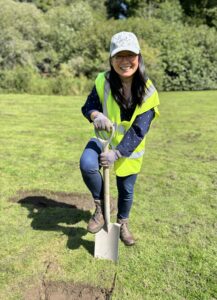
De-turfing after measuring out our dig site.
Surprises lay in wait
What surprised the team from the start was the abundance of finds lying undisturbed just below the surface. The first find was from the recent past – a one-pound coin from 1985. Objects such as the coin were easy to identify and date, however others proved more challenging, so it was fantastic to hear the thoughts of the participants when an unidentified artefact appeared!
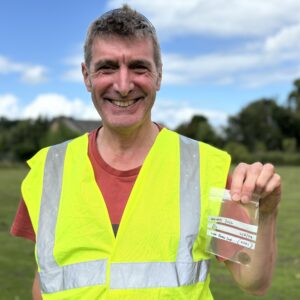
The very first find of the Big Dig!
As the dig continued, older objects appeared and our eager participants began finding a wealth of evidence spanning hundreds of years, including:
- Two broken bricks; a National Coal Board brick from Prestongrange which dates from between 1947 and 1969 and another from Arniston was stamped 1872.
- Two pieces of clay pipe stem, one with maker’s markings. The maker’s stamp means it is very probable that it was produced by Thomas White & Co of Edinburgh during the 19th century.
- A small metal cylindrical object, that participants interpreted as the handle of a safety razor or a magnifying glass handle.
- Various pieces of glass, including part of a green glass bottle with the mark ‘Edinburgh’
- A potential musket-ball
- Pottery sherds with different glazes, patterns and fabric (material)
- Lots of building material including sandy mortar and iron nails
- Lots of metal objects, some interpreted as bucket handles, ironmongery and barbed wire!
- Charcoal and possible coke and slag – evidence for past energy resources
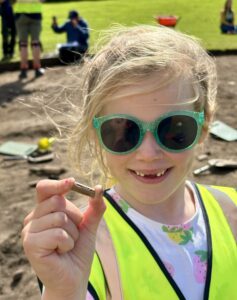
A clay pipe stem with a maker’s mark.
A late medieval find
Throughout the excavation, sherds of a light green glazed ceramic were discovered. Most were close to the surface, and by the end of the dig more than 15 sherds had been recovered. This type of pottery is late-Medieval in date and would tie-in very nicely with the Abbey complex that was founded by the Cistercian monks in the 12th century and its church dedicated in the 13th century. One thick, dark sherd of pottery may even date to the very start of Newbattle’s human past thousands of years ago; the analysis continues!
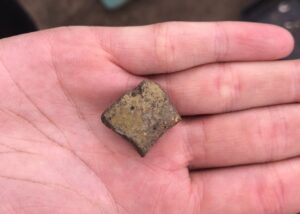
One sherd of green glazed ware. This may have been part of a jug used by the medieval monks at Newbattle Abbey.
The most frequently asked question…have we found the trench yet?
After a couple of days digging in glorious weather, the search for the Second World War practice trench revealed a discernible line of lighter soil running across the excavation trench. A smaller, deeper slot was dug and it became clear that the lighter, sandy material was the top of a later backfill.
After more excavation, the sides of the original trench could be seen. Whilst it’s profile and backfill provided compelling evidence for the existence of the practice trench, it was the right-angle turn in another slot and the late discovery of two surviving timber boards running along the sides of the trench, (and the faint hint of trench boards at the base), that confirmed that the team had indeed found the practice trench!
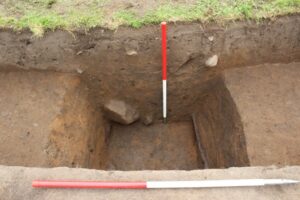
The fully excavated World War II practice trench. The 1 meter scale shows the depth and width. On the right side of the base of the trench, a wooden plank is visible.
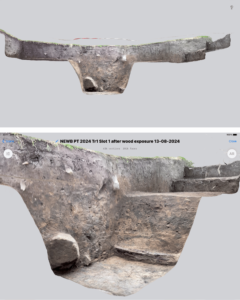
3D Scans of the trench.
To view a video of the 3D scan, click here
The second slot also revealed an archaeological feature we hadn’t expected; a series of possible stake holes (well spotted by a participant!) which suggest that a fence had followed the course of the practice trench and may indeed have held up barbed-wire.
Participants and passers-by with lived experience of the military, family histories of the Second World War and community connections with the training camp at Newbattle shared their knowledge, experience and expertise which we thank them for. We were pleased that by using archaeology as a tool to find and connect with this history and community, we uncovered the past, shared knowledge and stories, and found the answer to our research question together.
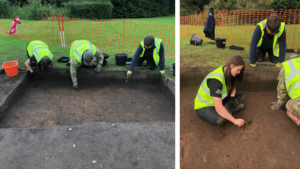
Left – A participant noticed an intriguing archaeological feature; post-holes on the outside of the trench crenellation (corner). Right – Carefully excavating the post-holes.
“It’s been quite inspiring because when we were uncovering the pole holes, for example, everybody was sort of standing around and I took a step back and just listened to what everybody was saying, and everybody had a different idea of what the poles might have been used for but nobody’s idea was dismissed. Everybody’s idea was embraced and everybody had an input in what they could be. And I just found that just so fantastic that you could come down here an absolute layperson and still be appreciated for your views and ideas.” (Participant)
It takes more than bricks and mortar…
“Oh! I’m better at maths than I thought I was.” (Participant)
Archaeology involves a number of skills that use Science, Technology, Engineering and Maths; during Desk Based Assessment research, the digging itself, as well as recording, analysing and interpreting finds and features. Participants flexed their numeracy skills while marking out the dig and recording a scale section drawing of the practice trench. Meta-skills such as focusing, sense-making and communicating are also important skills for archaeologists that participants used every day.
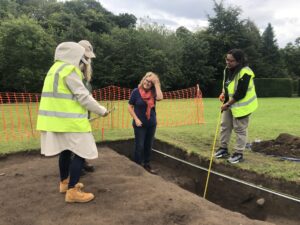
Using Numeracy skills to measure and record a scale drawing of a ‘section’ of the Second World War practice trench.
The Archaeology Scotland learning team designed and ran activities that supported and developed these STEM skills, by exploring different building materials past and present, as well as discussing sustainable building materials of the future using Kenoteq’s K-Briq.
Using the surrounding Second World War buildings as inspiration, participants used ratio, tessellation, calculation, as well as meta-skills including adapting, collaborating and critical thinking to work together to build a reconstruction to scale. Younger participants also experimented with different styles of brickwork, exploring stability, foundations, and linking new concepts to the world around them.
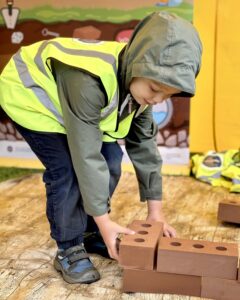
Exploring building materials to make a right-angled corner.
“Right at the very beginning where we started marking out the trench, up pops Pythagoras theorem and I was like, Oh my goodness… but it was explained really well… Each corner has to be a perfect right angle. Who knew? …None of us volunteers, I would argue knew that you worked on grid references.” (Participant)
The finds of bricks, mortar, masonry nails and window glass were especially exciting for the participants, groups and passers-by who took part in our activities involving STEM skills. Mixing mortar was a sticky but popular activity involving ratio (and curiosity!). This activity brought the archaeology to life, as participants compared the activity’s building materials to those they and others had just found while digging, creating great discussions on how, why and when different materials were used.
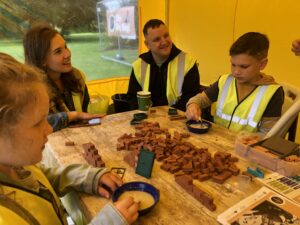
After working hard excavating, this family made mortar to different ratios and used tessellation to build together.
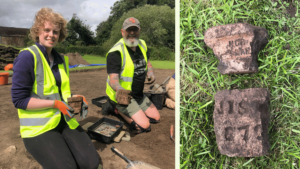
Left: Finding bricks in the bank material next to the trench – complete with the manufacturers’ location and date! Right: We did a little bit of trench-side research to find out where and when these bricks were made.
Energy Through Time at the Big Dig
One material we constantly came across was charcoal, and pieces of heated material that appear to be coke and slag (as well as a few finds of shale). These finds captured the interest and imagination of participants, as they had looked at the historic maps throughout time from the National Library of Scotland, and learned that the Cistercian Monks at Newbattle Abbey were the first coal miners in Scotland. The National Coal Board brick was another star of the dig, with many passers-by sharing their family histories about coal mining in Scotland.
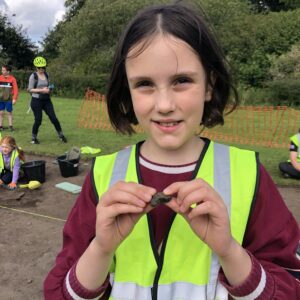
Finding evidence of industry waste! This well-spotted find shows the different resources local people were using and making in the past.
Looking at historic maps, holding finds, and for some learning about this local 800-year history of coal mining for the first time, it was a tangible experience of energy use and resources in the past, which led to fascinating discussions about our current and future energy use, and sustainable energy sources.
What’s next for the Big Dig?
After a Big Dig full of conversation, connection, STEM skill building and archaeological learning (not to mention the large amount of finds!), we have drawn the last plan sketch, taken the last photo, bagged the last find and laid the last turf back on top of our Big Dig.
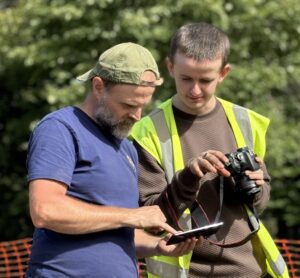
Recording the section of the practice trench. Photography is an important skill for archaeologists.
We would like to wish all of the wonderful participants, students, groups and passers-by a big thank you for all of their time, hard work, excellent conversations and funny, fascinating and inspiring times had during the Big Dig. We would also like to thank Newbattle Abbey College for their permission to dig and helpful involvement, Social Bite for the delicious sandwiches enjoyed by the participants and to everyone who shared information about the Big Dig with their networks, colleagues, families, friends and neighbours. Thanks also to Mark Cranston for his incredible collection and database of Scottish Bricks.
Thanks to our supporters and funders who made this invaluable dig, activities and impact possible: Scottish Power Foundation, Edinburgh University Local, AOC Archaeology Group, Historic Environment Scotland, Newbattle Abbey College and East Lothian Works.
The work now begins to research our finds, write up our Archaeological Report, and analyse the impact of our dig using participant feedback. If you were a participant or a passer-by and would like to give your feedback on the Big Dig, please email education@archaeologyscotland.org.uk. Your feedback is highly appreciated.
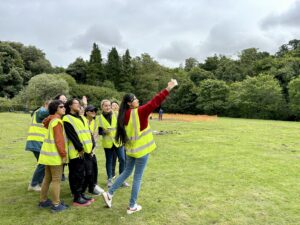
The Big Dig was Big Fun thanks to all of our fantastic participants!
Watch our short film: Celebrating the Big Dig at Newbattle Abbey College
Want to learn more or get involved?
- Join Archaeology Scotland as a member to support community projects like the Big Dig.
- Subscribe to Archaeology Scotland’s newsletter.
- Get involved in an event near you during Scottish Archaeology Month in September.
- Stay up to date with archaeology news, updates and opportunities in Scotland by following us on Social Media:
–X/Twitter
–Facebook
–Instagram
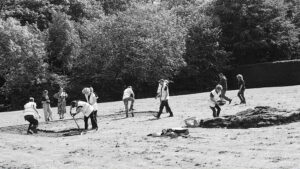
Thanks to participant Daisy for sharing her photography skills and taking this great shot of the team de-turfing the Big Dig site.