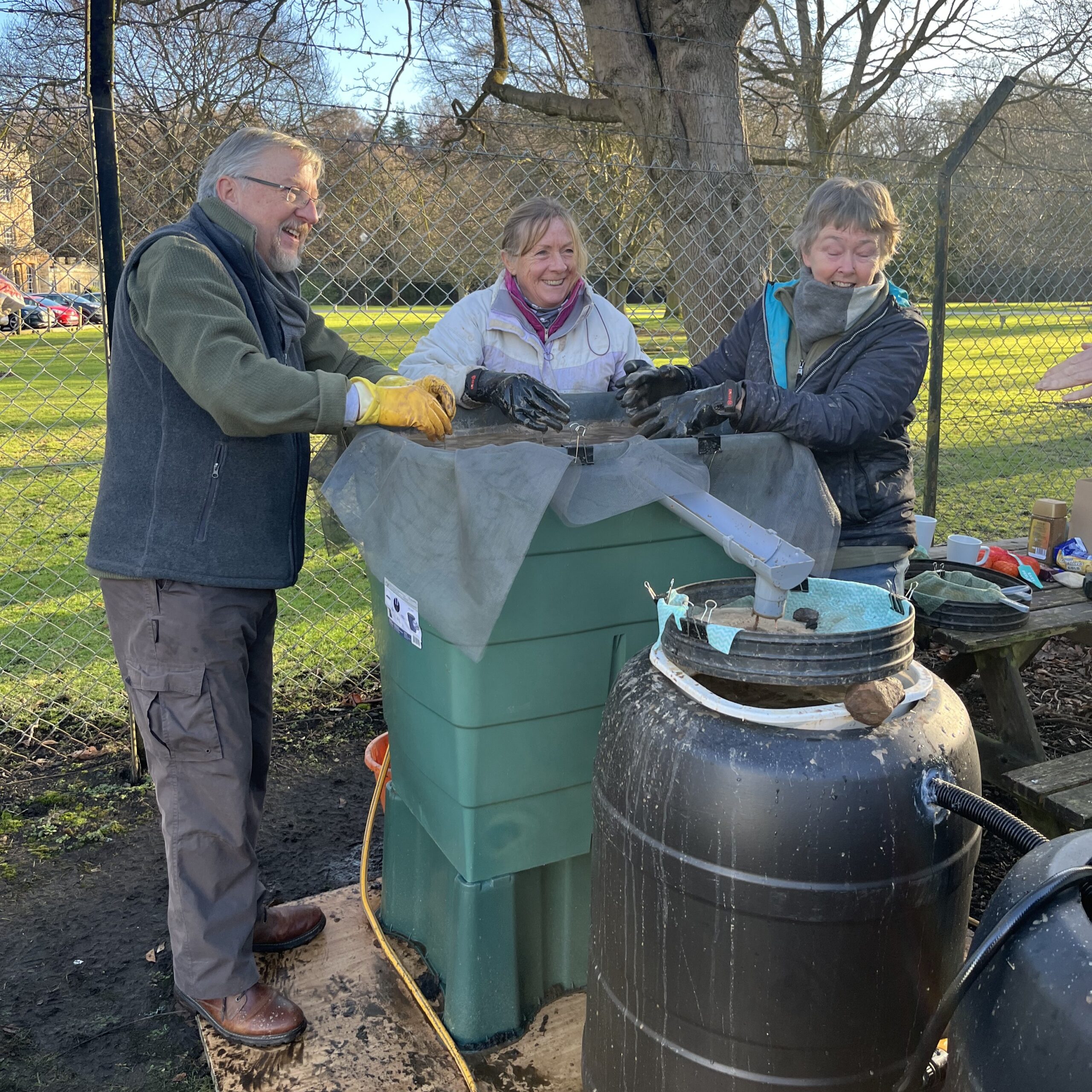
(Above) Volunteers ‘agitate’ a sample from Bedrule in the sunshine. The mesh they are leaning on catches the ‘res’ at the bottom , and the blue cloth above the black barrel catches the ‘flot’ that has floated along the waters’ surface and down the pipe. Ian Hill built this impressive rig and made sure we used a fresh mesh and cloth for each new sample.
Words by Calypso Finch, Learning Assistant.
Over a few bright days in January, Archaeology Scotland’s Adopt-a-Monument team and Ian Hill (Director of Harp Archaeology) ran some informative (and very fun) wet-sieving training for volunteers from the Glendaruel and Bedrule excavations, who were joined by some Archaeology Scotland staff members. It was my first time wet sieving, and it was a blast!
Together we processed the soil samples that were taken during the excavations, to collect any artefacts and ‘ecofacts’ from the soil. The ‘ecofacts’ are very important as they are organic material, so can be carbon-dated, which adds invaluable information to the story of each site. During the excavations, specific contexts had been carefully targeted and sampled in order to capture this evidence.
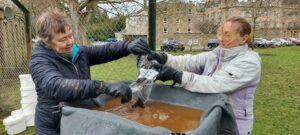
Andy Jepson, Project Officer at Archaeology Scotland captured the exciting moment that volunteers kicked off the wet sieving process by emptying a soil sample from Glendaruel into the flotation tank. In the background, soil sample buckets await their turn for a dip in the tank.
Wet sieving works exactly as it sounds – you need water, a sieve, and a soil sample! The process starts by submerging one sample at a time in a filter-lined flotation tank, and using our hands to gently ‘agitate’ the soil, clay and gravel under the water. As we worked on removing the mud and silt from the submerged sample, light ecofacts such as charred grains and hazelnut shells floated to the top, while we found other artefacts including pottery, daub and burnt bone amongst the ‘res’ (residue) at the bottom.
The ‘flots’ (floating ecofacts) are channelled to run off the surface of the floatation tank and caught in a filter. We also collected flots from the surface of the water by hand (that’s where the sieving comes in!). Once the mud has been washed away through the cloth filter and the flot has been collected, everything that remains at the bottom gets put aside to dry. The next task is painstakingly sorting through what is left with a magnifying glass and tweezers to make sure all of the artefacts and ecofacts have been collected, labelled and united with the finds from the excavation (or sent off for analysis and dating).
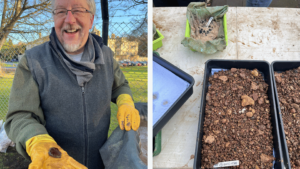
(Left) Hiding amongst the ‘res’ was this piece of medieval green glazed ware, which was happily reunited with the rest of the pottery sherds found in the same context during last year’s excavation at Bedrule! (Right) And here is what it is all for… The ‘res’ is lying out to dry before it will be inspected for artefacts and ecofacts. Eagle-eyed readers might be able to spot daub, burnt bone and the odd charred grain. In the smaller green tray lies the ‘flot’ from the same sample, with some nice big pieces of charcoal.
We want to wish our volunteers a big thank you for their hard work and commitment, and Ian for his fantastic training. We found some brilliant ecofacts including burnt grains and hazlenut shell, as well as artefacts including fragments of burnt bone, mortar and daub. We were thrilled to find some medieval green-glazed pottery in one of the Bedrule samples that appeared to be part of the same vessel found during the excavation! The volunteers from Glendaruel enjoyed following the samples’ journey a bit further.
We look forward to sharing more updates in the future. I can’t wait for the next time we get the flotation tank out, and the marigolds on…
You can stay up to date with Adopt-a-Monument here:
Adopt-a-Monument (@AdoptaMonument) / X
In the meantime, you can read up on the Bedrule and Glendaruel projects here: