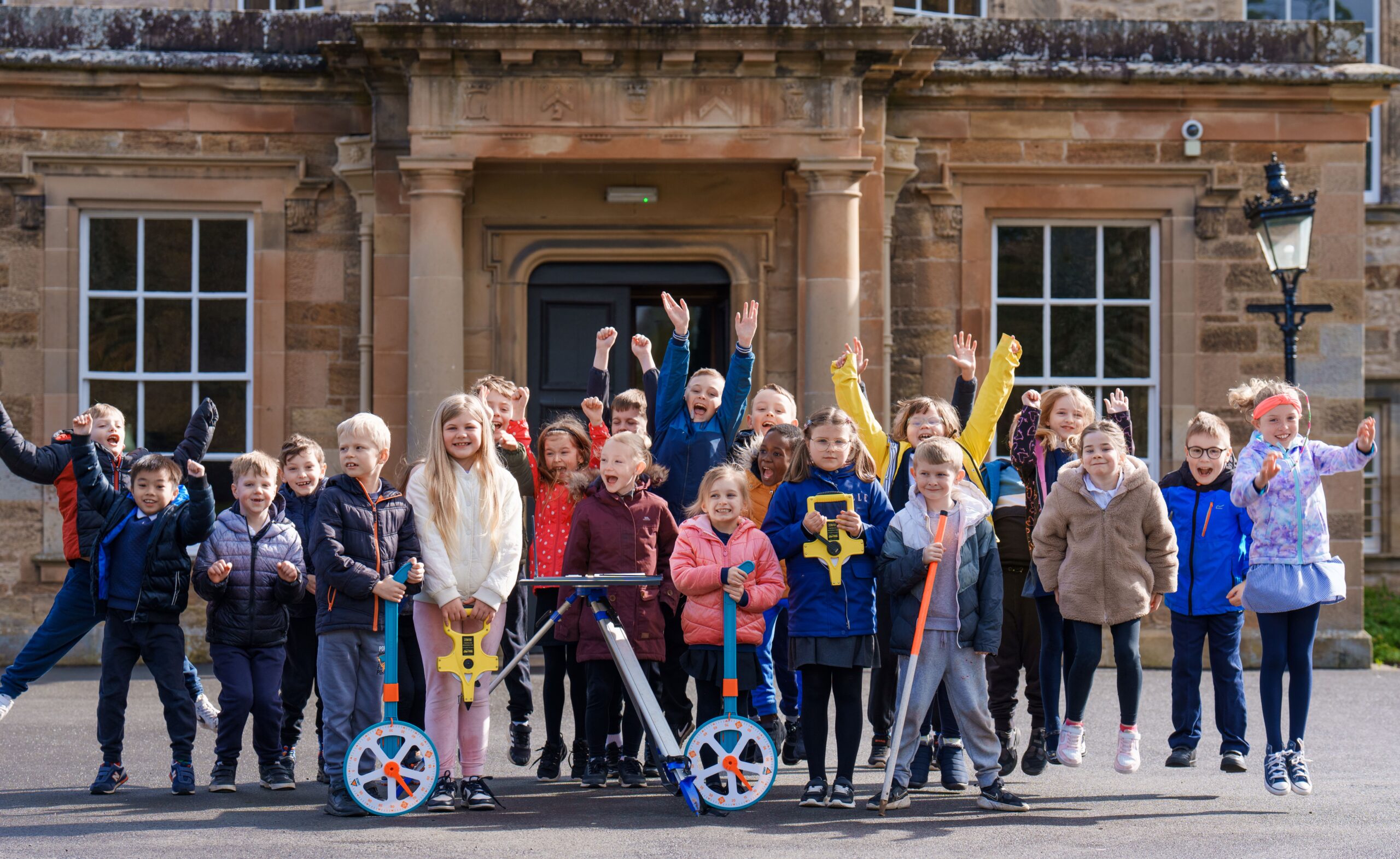
Energy through Time is a year-long learning project that uses archaeology to investigate how people and communities lived in the past, how they harnessed the energy sources and natural resources around them, and what day to day life looked like hundreds (and thousands) of years ago!
This project is funded by the Scottish Power Foundation and Historic Environment Scotland and delivered by Archaeology Scotland’s learning team. Read on to find out what it is all about, what we have discovered so far, and why it is so important today. Want to get involved? Find out how at the end of this blog…
What has archaeology got to do with energy?
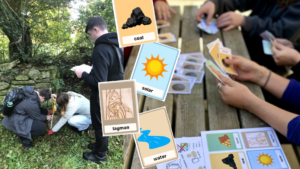
Participants exploring a site using historic building recording (left). Participants used a card game (right) to explore local natural resources and energy sources, and discuss their pros, cons, and impacts on communities and the environment.
We have been busy working with educational and community groups to learn about past ‘energyscapes’ in Scotland. This project has also helped young people from disadvantaged backgrounds to develop transferable skills and build their understanding of archaeology and STEM (Science, Technology, Engineering and Maths). Together we investigated how people harnessed and developed energy sources and technology to power their homes and communities in the past, by investigating the archaeology of local sites and landscapes.
Archaeology helps us uncover the stories of everyone in the past, not just the wealthy or influential few recorded in history. It connects us to the everyday life of people living in Scotland throughout time, and also helps us understand and respect the different ways people harnessed energy in the past and how they used this energy for food, work and play.
In the present day, it’s easy to see evidence for harnessing and using energy all around us, from wind turbines to power stations, when we flick on a light-switch or plug in a device. Today, you can visit brilliant museums like Scotland’s National Mining Museum to delve into how Scotland harnessed energy in the past. However, to find out about the local energyscape of each group, we turned to archaeological investigation, skills and techniques to uncover evidence of energy harnessing and use in the past.
How do you find out about past ‘energyscapes’?
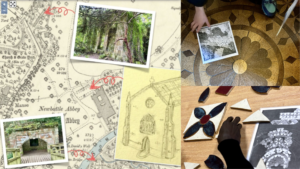
A historic map, modern photographs, and an interpretive illustration of Newbattle Abbey drawn by one of the young participants (left), reconstructing archaeological evidence using a site visit and tiles (right).
All across Scotland, there is incredible evidence of communities harnessing different energy sources in the past (and in the present). During our project, we delved deeper into how people made the most of these resources, how this developed and changed with technology and industry, and compared it to our energy in the present day. We learned how changes in industry, technology and even climate change affected different communities and energyscapes unequally.
Here are some of the ways groups investigated past energyscapes in their local area:
- Visiting sites and handling artefacts
- Looking at and comparing historic maps, records and images (illustration, photos)
- Looking at previous archaeological reports and artefacts
- Historic building recording skills
- Oral history and connection with the community
So, what did we find?

A young person recreates a burial using a skeleton model in the location they were buried. We explored how osteoarchaeological (bone) evidence can tell us about how people lived. This skeleton showed heavy strain on the lower back, which could reveal the physical toll of early coal mining on the working ‘laymen’ at the medieval abbey.
We interpreted the evidence we uncovered in different ways (including video, art, displays, games, replicas and writing). But our learning isn’t all about investigating the past, it is also about sharing our learning and informing our future.
Archaeology is a powerful tool to help us learn from the past to imagine how we could live more sustainably in the future as a community. During our project, participants were surprised and excited to discover the energy-efficient and sustainable ways that people in the past have grown and processed food, as well as keeping cool and warm.
We also learned about positive and negative impacts of different energy sources and uses on communities and landscapes, and how these impacts were experienced differently and unequally by different groups.
Here are some examples of the energyscapes we investigated:
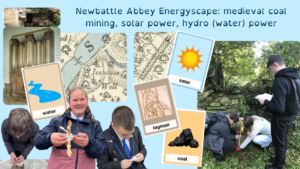
A group investigates the Newbattle Abbey energyscape of coal, solar and water power.
An Energyscape in Midlothian at Newbattle Abbey
- We learned about the first recorded coalminers in Scotland (medieval monks!) using site visits, artefact handling, historic maps, historic building recording and historical and modern sources.
- We explored sustainable ways to keep food cool in a no-energy fridge (Icehouse) and how people made the most of Scottish sunshine to grow fruit and plants (in an Orangery).
- In our search for secret tunnels and passageways, we learned about a renewable energy technology that dates back to ancient Greece (a water-powered organ).
- We also learned about the more recent coal mining connection during our Big Dig 2024, with finds and conversations highlighting coal connections for participants and passers-by. You can read more about what we found here and watch the video here.
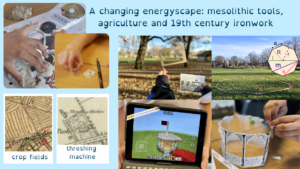
A group in Trinity investigate their local area, from the Mesolithic to the 20th Century.
Energyscapes in Trinity and Leith
- We explored local natural resources and materials and their uses throughout time, by handling and recreating artefacts and making cordage.
- We had a mock excavation and recorded the excavation site as well as artefacts.
- We explored evidence for changing use of materials, the land and technology over time, from farmland to public park, using artefacts, historic maps and photographs.
- Using measurement, art and technology, we interpreted and recreated a historic building that no longer exists!
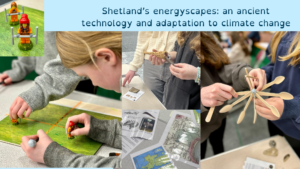
Students at Shetland Science Fair use ‘geophysics’, historic maps and artefacts to investigate a local renewable energy technology, as well as having a go at making their own and testing them!
An Energyscape in Shetland
- We brought Energy Through Time workshops to Shetland Science Fair 2024, and with over 260 S2 and S3 pupils from all 7 of Shetland’s high and junior high schools, we investigated ancient renewable energy technology and adaptation to climate change, using archaeological evidence, scientific techniques and experimental archaeology. We held artefacts and discussed local materials and their uses.
- With over 800 examples across the Shetland Isles, we explored evidence for horizontal ‘Norse’ water mills using historic maps and aerial photographs to locate them. We tried our hand at making our own water wheels (tirls) using evidence, adjusting our designs after testing them to make them more efficient.
- Using previous archaeological reports, historic maps, ‘geophysics’ and an interactive demonstration of coastal erosion, we learned about the ‘Old house of Broo’ which had been buried by storms in the Little Ice Age. We discussed climate change, adaptation stories and thought about future energyscapes of Shetland, as the archaeological evidence of Broo reveals unequal impacts of climate change, adaptation to extreme weather events.
- Using a simple hands-on experiment, we explored the impact of climate change and coastal erosion on archaeological sites along Shetland’s coast.
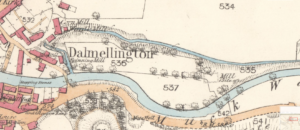
Map of Dalmellington, NLS OS Ayrshire XLVI.16 (Dalmellington) Survey date 1856. Reproduced with the permission of the National Library of Scotland – Map images – National Library of Scotland – https://maps.nls.uk/
An Energyscapes in East Ayrshire
- Pupils from Bellsbank Primary School explored their local landscape and heritage as part of the Coalfield Communities Landscape Partnership project.
- We compared historic and modern maps to see how Bellsbank has changed over time – looking for evidence of growing populations, changing occupations, sources of energy and changes in land use. This led to a discussion about the impact of the coalmining industry on the area, its landscapes and its communities.
- Pupils found evidence for a lade, sluice gates a corn mill, spinning mill and ruins of former mills on the historic maps. Using a variety of materials, pupils designed and made their own waterwheels which were then tested to see how efficiently they worked and if any adjustments were required.
Power to the people?
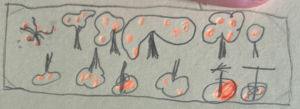
An orangery for the community
Together, we discussed the ‘pros and cons’ of each past energy source, and their varied impacts on people and planet, as well as discussing and designing ways that we can support our communities by harnessing renewable energy into the future. By learning from our past energyscapes, we are imagining better, sustainable energy futures for all.
The ‘for all’ part is very important so that we can meet our country-wide goal of transitioning from fossil fuels to renewable energy and reducing our greenhouse gas emissions to Net Zero by 2045 in a way that doesn’t leave anyone behind. You can read more about the Just Transition here.
Here are some of the ideas groups came up with to benefit communities and the environment by harnessing natural resources and renewable energy:
- Harness solar energy to grow food locally in orangeries (greenhouses)
- Build ice-houses to make large zero carbon fridges for communities
- Build water-mills to charge batteries and provide electricity (including horizontal mills to make the most of Scotland’s water, especially in the winter!)
The project so far
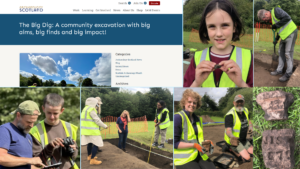
The Big Dig 2024 gave the local community an opportunity to learn excavation skills in their local area, while developing Meta-Skills and STEM skills, as well as uncovering evidence of past energyscapes.
So far, Archaeology Scotland has delivered 27 one-off workshops, (including co-design workshops), 5 Attainment through Archaeology Taster sessions and 4 x 5-workshop Attainment through Archaeology courses, with participants achieving Heritage Hero Awards! We want to thank everyone involved in the project so far, including over 400 school-age children, over 45 young people (16-25) and over 95 adults, as well as over 40 staff and volunteer partners.
Engaging with archaeology as part of our Energy Through Time project promotes development of STEM (Science, Technology, Engineering and Maths) and Meta-Skills, as well as contributing positively to wellbeing. In our evaluation feedback we received from groups, participants have developed skills and received positive wellbeing impacts, as well as learning more about archaeology and their local area. Energy Through Time also contributes to learning and action on the United Nation’s Sustainable Development Goals.
And it doesn’t stop there… as the project continues, we are looking forward to running our free online sessions for educators in January and March! Come and join in, more information below.
How can I get involved?
Our Energy Through Time project will finish at the end of March 2025 and we will be sharing updates in our Learning Newsletters. To find out more about our upcoming projects and hear about new free learning resources, subscribe to our Learning Newsletter here.
As lead body for Aim 4 of Scotland’s Archaeology Strategy, we are passionate about encouraging greater engagement with Scotland’s archaeological heritage. Archaeology Scotland run and support various projects and progammes with, and for communities across Scotland. You can stay up to date with our work and how you can get involved by subscribing to our ‘Out and About’ Newsletter here.
You can borrow our free Industrial Archaeology Loan Kit made in partnership with the Scottish National Mining Museum Industrial Archaeology | Archaeology Scotland
You might be interested in designing and running your own community or education group heritage project about Energy Through Time, or a heritage or archaeology site that interests your group. Heritage Hero Awards is our wider achievement award recognising people’s time spent exploring, investigating, recording and sharing heritage and archaeology. To find out more about how your group can work towards this award, visit our website.
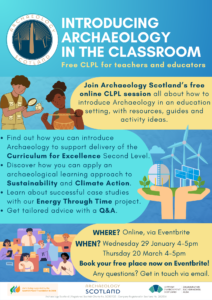
If you are a teacher, educator, community or interest group leader and want to find out how you can bring Archaeology into your group, make the most of technology and resources, or how to get started learning about Archaeology near you, come and join us for one of our free 1 hour online Career Long Professional Learning (CLPL) sessions in January or March!
You can use these resources, activities and ideas to run your own Energy through Time project.
To find out more click here for the information poster and book your free ticket below:
- CLPL – Introducing Archaeology in the Classroom Tickets, Wed 29 Jan 2025 at 16:00 | Eventbrite
- CLPL – Introducing Archaeology in the Classroom Tickets, Thu 20 Mar 2025 at 16:00 | Eventbrite
Want to learn more or get involved?
- Join Archaeology Scotland as a member to support community projects like the Big Dig.
- Subscribe to Archaeology Scotland’s newsletter.
- Stay up to date with archaeology news, updates and opportunities in Scotland by following us on Social Media:
–X/Twitter
–Facebook
–Instagram
–Bluesky
Links and further reading:
- The Just Transition – Just transition – Climate change – gov.scot
- Net Zero 2045 – Home | Net Zero Nation
- Scottish Power Foundation – ScottishPower Foundation – ScottishPower
- Coalfield Communities Landscape Partnership – Coalfield Communities – Communities Landscape Projects
- Scotland’s National Mining Museum – nationalminingmuseum.com
- Shetland’s water mills – Self sufficiency in action: Shetland’s ancient mills | Shetland.org
- Quendale – Place-name of the week – Mills | Shetland Amenity Trust
- The Old House of Broo, Quendale –
- Little Ice Age catastrophic storms and the destruction of a Shetland Island community – ScienceDirect
- Sustainable Development Goals – Home – United Nations Sustainable Development
- Excavation at Newbattle Abbey – Excavation at Newbattle Abbey College Annexe, Dalkeith, Midlothian | Proceedings of the Society of Antiquaries of Scotland
- The Big Dig 2024 Video – Celebrating the ‘Big Dig’ at Newbattle Abbey College – YouTube
- The Big Dig 2024 blog – read here
- All maps, included adapted maps in the educational resources – Reproduced with the permission of the National Library of Scotland Map images – National Library of Scotland (under non-commercial and educational Creative Commons license) Deed – Attribution 4.0 International – Creative Commons