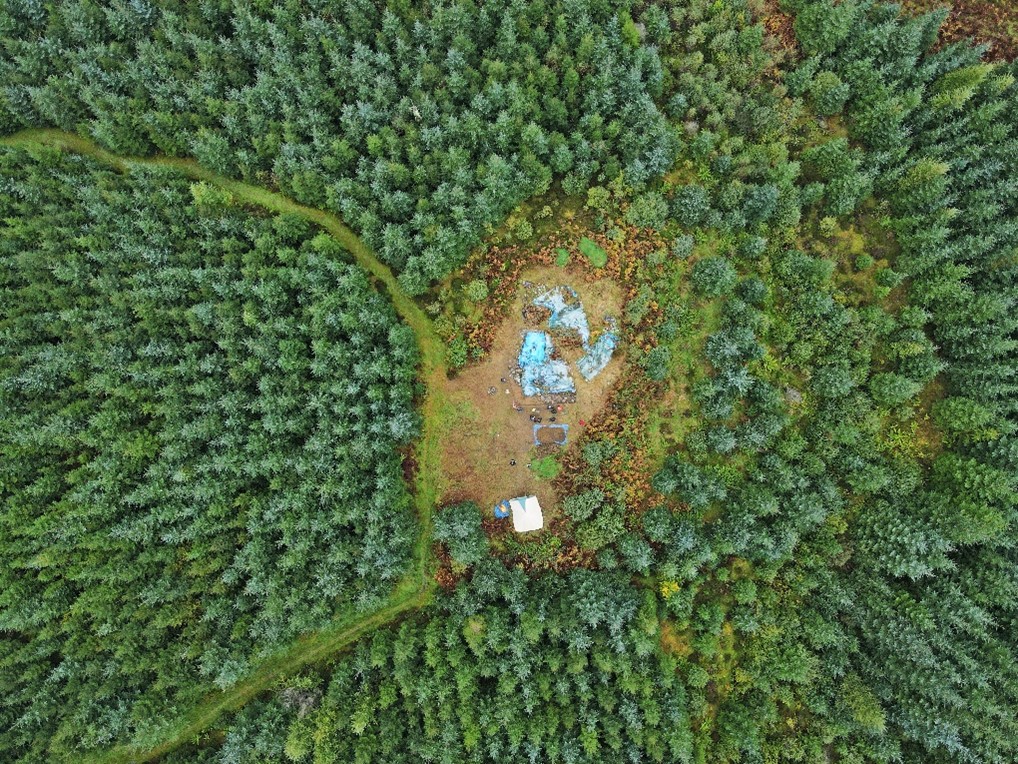
Drone view of Creag Liath site, 2025 by Jim Hunter.
It’s Time to Dig!
The first two days of our 2025 Creag Liath community excavation have seen a fantastic effort to extend last year’s trenches thanks to a team of intrepid volunteers from the Stronafian Community Forest and local community. It has been wonderful to see the interest in the project grow in recent years; on day 1 this year we welcomed 11 volunteers and on day 2 some 15 volunteers joined in to play their part in helping reveal the story of the enigmatic “Grey Stones” site and contribute to the excavations that began in 2022.
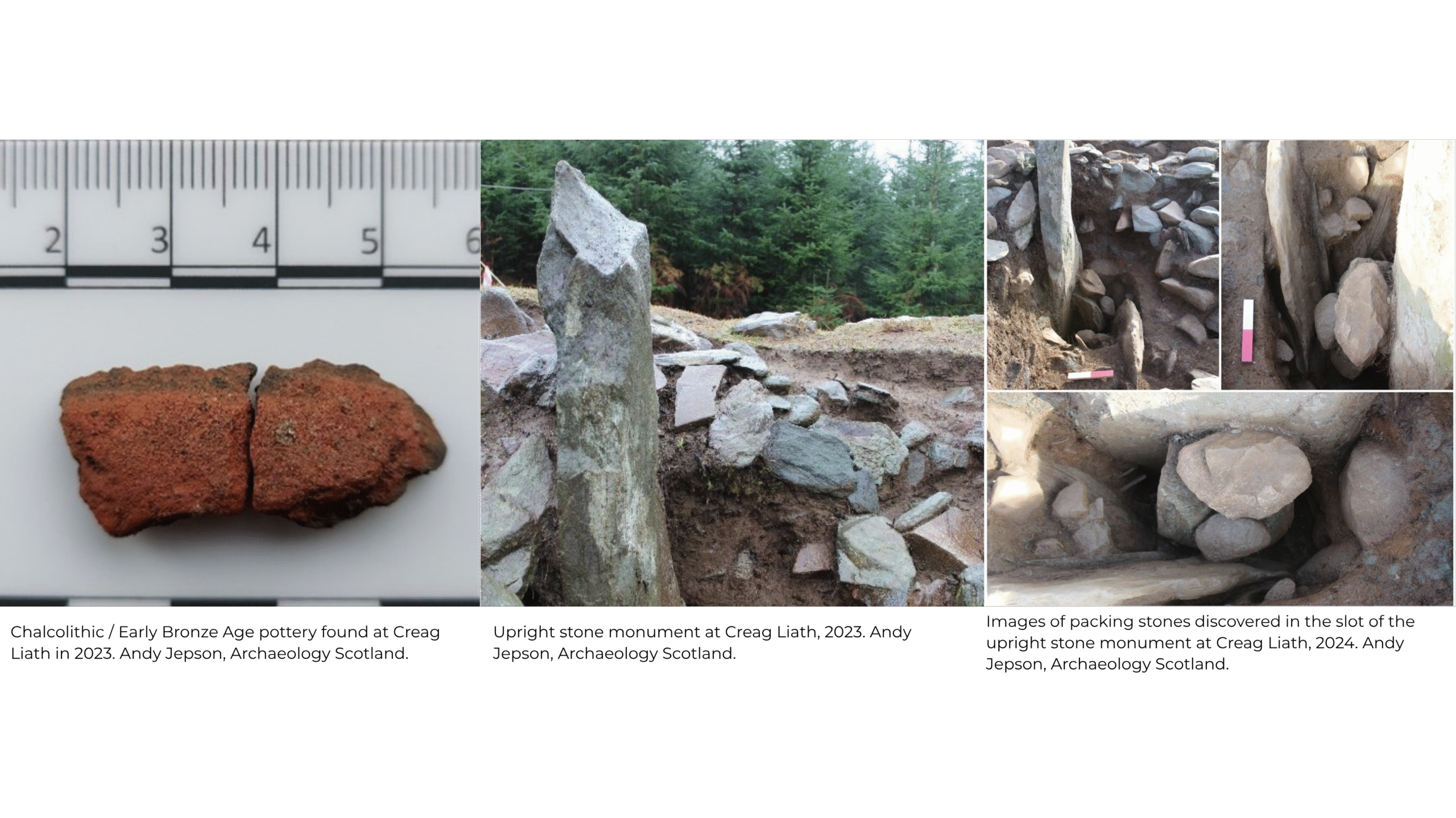
From finding two pottery sherds of reddish-brown gritty ware in 2023, likely to originate from a Chalcolithic/Early Bronze Age beaker, to 2024’s partial excavation of a slot holding our upright stone monument and the discovery of coloured packing stones, our focus in 2025 has been to extend Trench 1 to gather more information about our main structure.
In just a few days the team has revealed more stone (yes, it’s called “grey stones” for a reason!) and are already beginning to contribute to the interpretation of what is being discovered. Archaeology Scotland would like to thank everyone who has dug, surveyed, given lifts, home baked (yum!) and maintained those precious smiles even when the weather has been challenging!
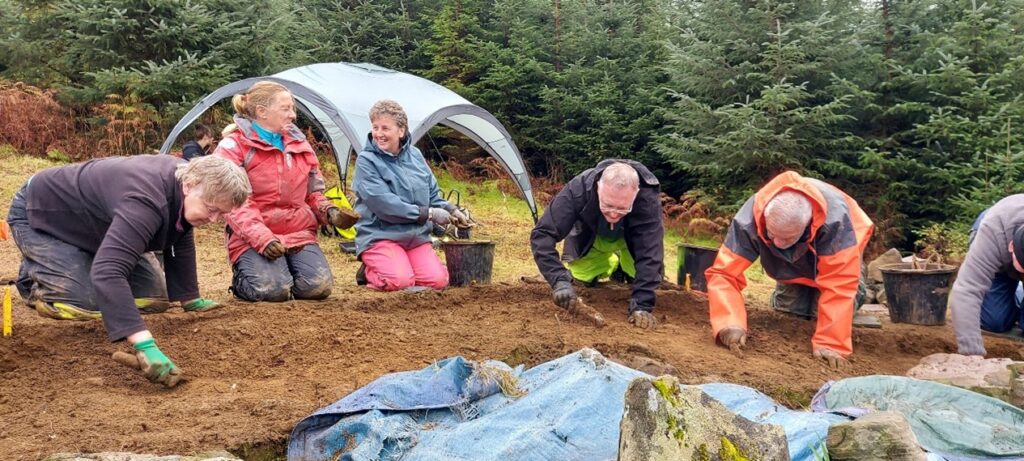
Volunteers excavating at Creag Liath, 2025. Andy Jepson, Archaeology Scotland.
A change of focus! Volunteers from the Stronafian Community Forest took a day out from our current dig at Creag Liath to visit a number of fascinating archaeological sites in the forest with prehistoric origins, including the multi-period settlement at Auchategan excavated in the late 1960s, the Clyde-type Neolithic chambered long cairn at Lephinkill and a Cup and Ring Marked Stone that had been laser-scanned back in 2018.
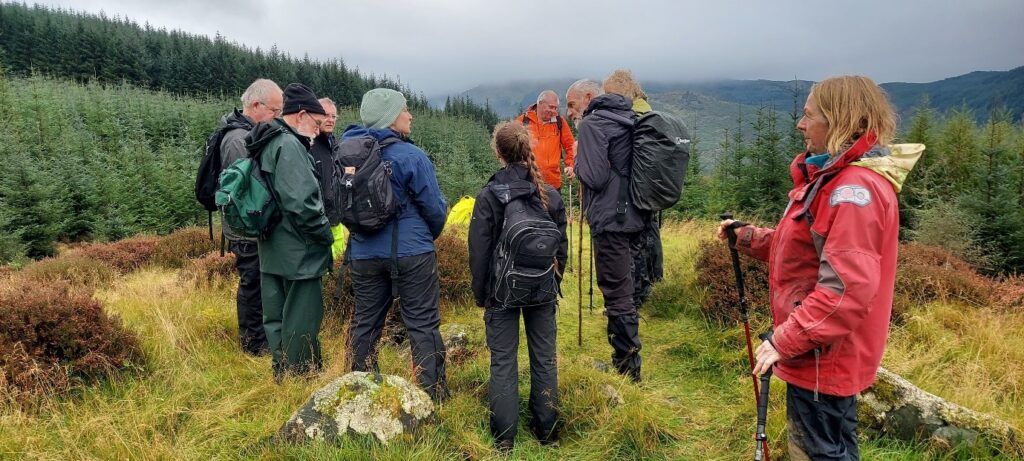
Volunteers visiting archaeological sites at Stronafian, 2025. Andy Jepson, Archaeology Scotland.
The story of Auchategan and its discovery remains as exciting today as it was nearly 60 years ago. What started out as a search for St Modan’s Chapel the fieldwork ultimately revealed a series of occupation deposits sitting one on top of the other, including at its highest and most recent level, three hut circles or shielings, then a stone house with associated peat stack beneath them, then evidence of iron working dating to before the Medieval period, a post-hole hut dating from the Middle to Late Iron Age, two Bronze Age cists (one cremation, one inhumation) from the early Middle Bronze Age and finally two Neolithic occupation layers containing over 400 sherds of Neolithic pottery, two greenstone axeheads, a flint knife and flint arrow heads. It was such a privilege to be joined by Duncan MacIntyre who had attended Dorothy Marshall’s dig in the late 1960s there and to listen to the fascinating insights and stories of what it was like to dig such an important site in such esteemed company. In her lifetime Dorothy contributed significantly to Scottish archaeology and was a much loved and respected figure in the sector.
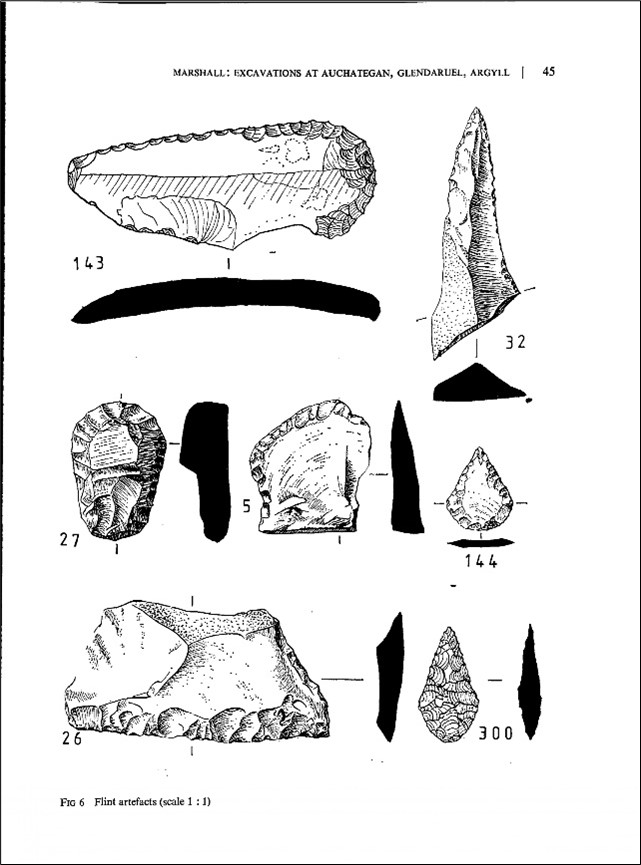
Extract from “Excavation at Auchategan, Glendaruel, Argyll” by D N Marshall. Image ref: Dorothy Marshall – p45.
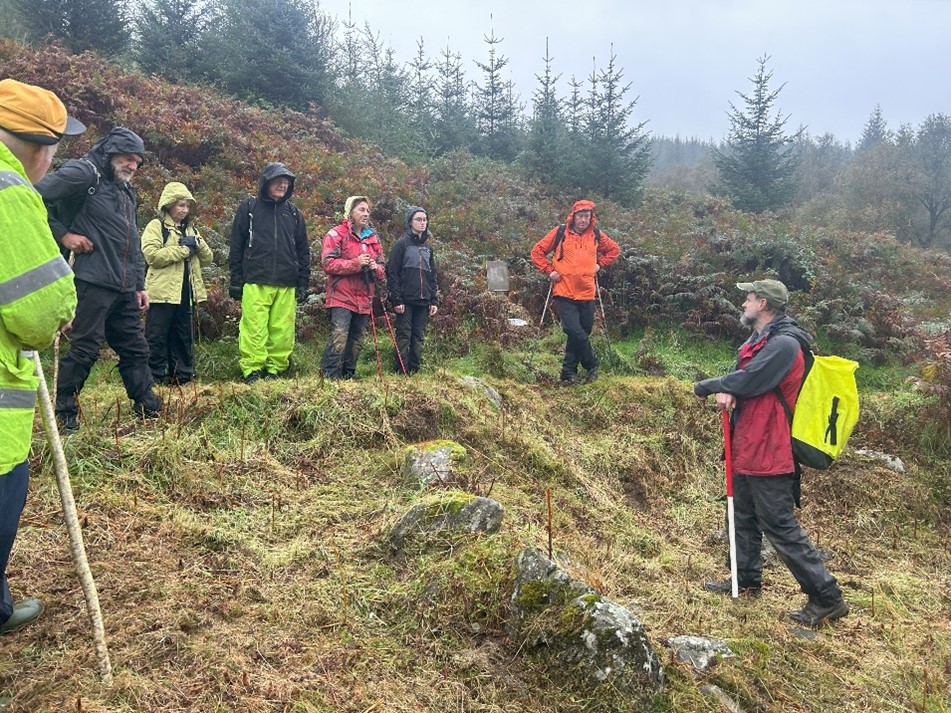
Discussing the options for interpretation of Auchategan village, 2025. Eleanor Harrison, Archaeology Scotland.
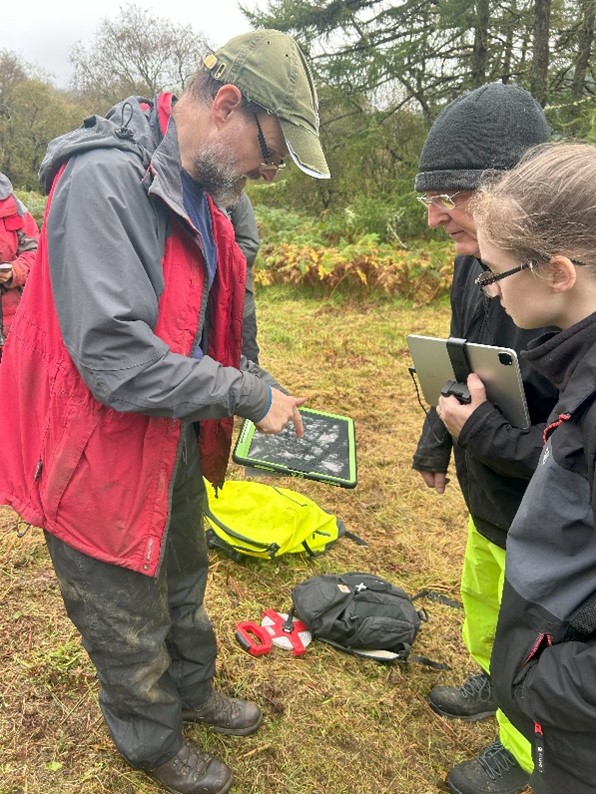
Exploring the multi-period site at Auchategan with the aid of site plans drawn in the late 1960s, 2025. Eleanor Harrison, Archaeology Scotland.
Chambered tombs are some of the best surviving Neolithic monuments in Britain today. The Neolithic period was a time of change. People had begun farming; some settled in more permanent places in the landscape while others continued to move around. There is regional variation but different communities were building tombs with a local variation. The long cairn at Lephinkill is a clyde-type tomb – there are at least a hundred in Scotland but they are also found in northern and western Ireland. They are characterised by a rectangular or trapezoidal-shaped mound of stones with a capped burial chamber and semi-circular forecourt. Most were surveyed by Audrey Henshall in the 1960s, another key figure in Scottish archaeology, celebrated for her meticulous work on prehistoric burials and Neolithic chambered tombs. She was one of Scotland’s first professional female archaeologists and made a significant contribution to Scottish Archaeology during her impressive career.
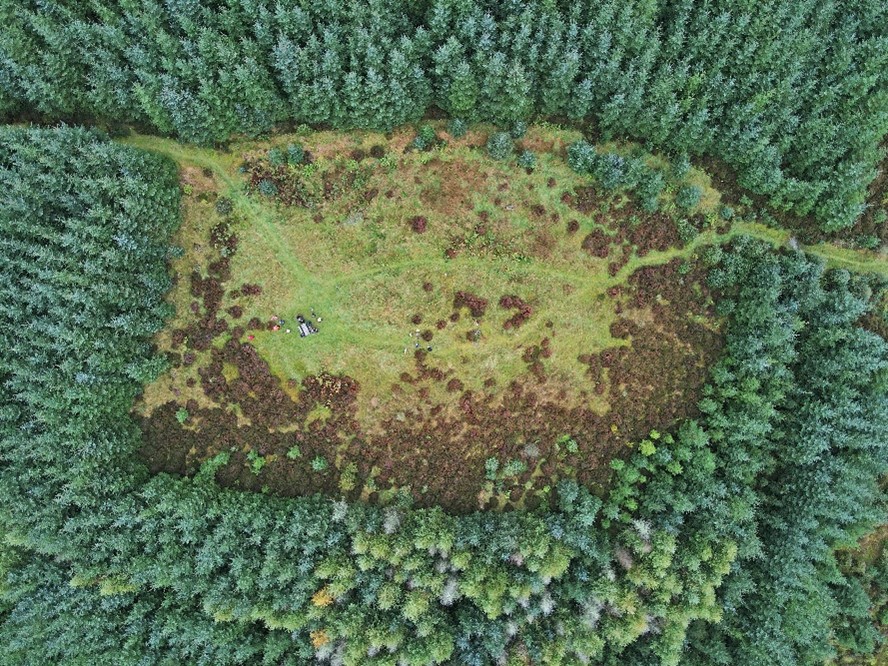
Drone view of Lephinkill Neolithic Chambered Cairn site, 2025. Jim Hunter.
Cup and ring-marked stones remain an enigmatic archaeological feature to this day. The panel at Stronafian is roughly triangular in shape and has numerous cup mark motifs, one of which is surrounded by a ring, on its flat upper surface. Both Susan and Gordon in our team had worked closely on digitally recording the motifs back in 2018 and it was lovely to see the pride and enthusiasm they retain from playing a part in that process.
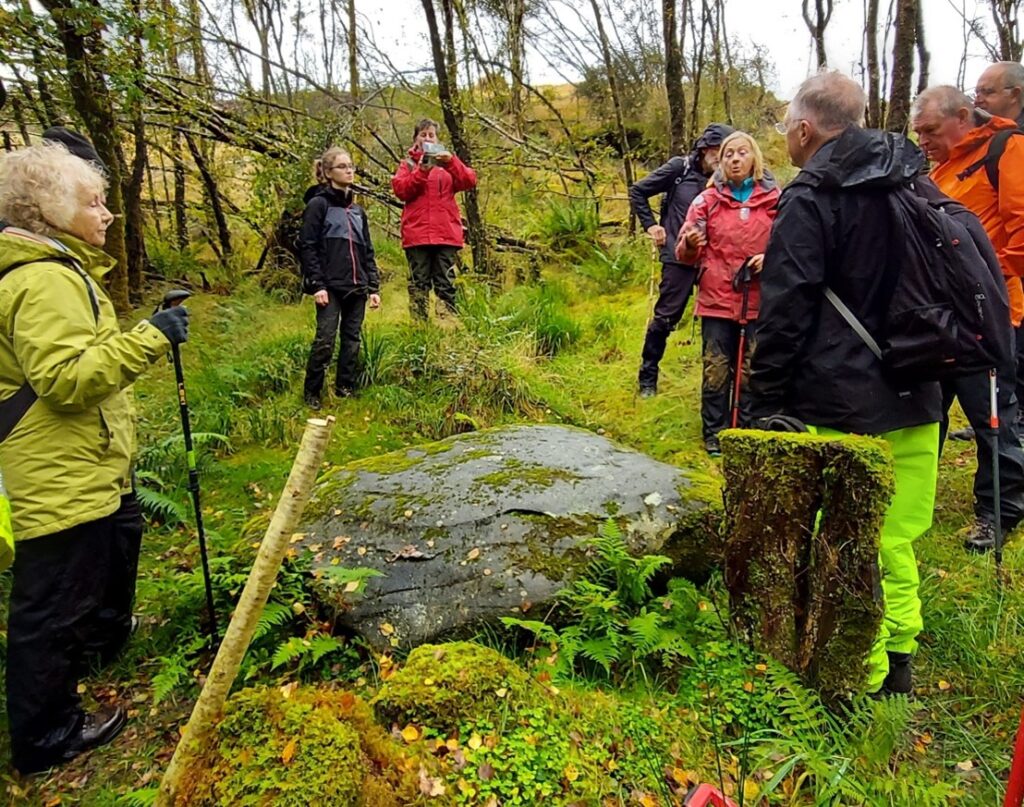
Auchategan Cup and Ring Marked Stone, 2025. Andy Jepson, Archaeology Scotland.
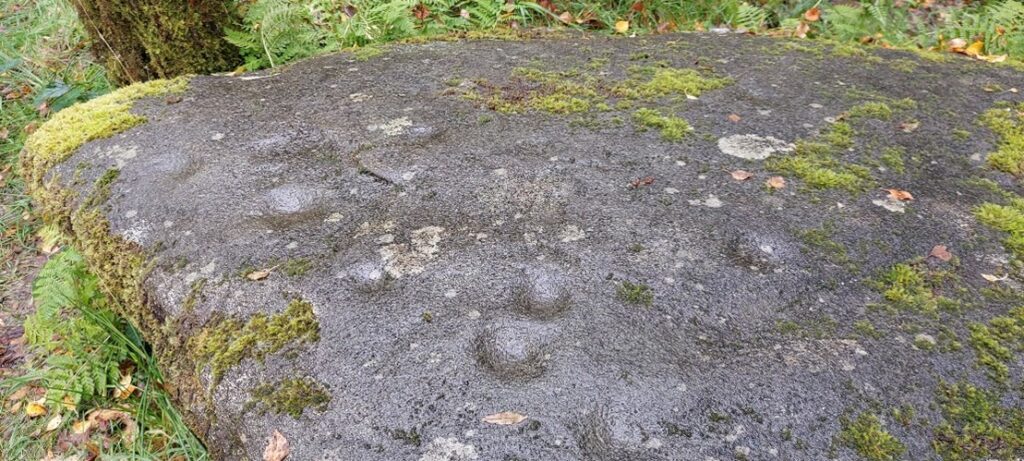
Detail of Auchategan Cup and Ring Marked Stone, 2025. Andy Jepson, Archaeology Scotland.
Further information on the work of the Stronafian Community Forest can be found at https://stronafianforest.org.uk/archaeology/.
And on Facebook at https://www.facebook.com/stronafianforest.
To read a short Archaeology Scotland blog published following the 2023 dig at Creag Liath head to https://www.archaeologyscotland.org.uk/reading-the-stones-exploring-a-possible-prehistoric-site-at-glendaruel-argyll-bute/.
Archaeology Scotland would like to thank all the volunteers from Stronafian Community Forest, Cowal Heritage Society, Kilmodan Primary School, Strachur Primary School and Dunoon Grammar who have taken part in recent excavations and for their help with the project. We would also like to thank the Colintraive and Glendaruel Development Trust. The project is funded by the Cruach Mhor Wind Farm Trust and Historic Environment Scotland.
Andrew Jepson, Archaeology Scotland – 2nd October 2025