The Corran to Ardgour ferry crossing takes just 5 minutes but it feels like the start of a journey to another world.
We’d moved from the bustle of Edinburgh, out past the Kelpies at Falkirk, all the way through to the tourist laden slopes of Glen Coe and then kept driving. What I had always thought of as the Highlands was now well behind us. As the van bumps up the ferry ramp, Phil announces that we are 2 hours from our destination. 2 hours! How could anything be 2 hours further on when we were already at the end of the world? I’m quickly distracted from this thought by our arrival at the first of the single track roads. I can see this road stretching out ahead, winding a gentle path around the shoreline but I can’t see around the next corner, nor the one after that. This was going to be a long drive.
This journey is the one of many that will form part of our ‘Scotland’s Earliest Megalithic Monuments’ Project and form part of a broader Adopt-a-Monument theme for this year. A central aim of this project is to celebrate the legacy of Audrey Henshall, a key figure in Scottish Archaeology perhaps best known for her comprehensive survey of Neolithic chambered tombs across Scotland. This is the first in a series of blog posts where I will take you with me as I follow in the footsteps of Audrey Henshall and other women who pioneered archaeological research into the Neolithic of the west coast of Scotland.
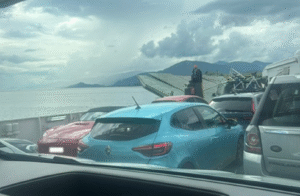
Our view from the Corran ferry, with Ardnamurchan ahead
Around 90 minutes in, we reach what Phil deems to be “real” Ardnamurchan. The landscape does look more rugged, volcanic rocks rising from patches of turf and the sea and silhouettes of the small isles emerging and receding as we twist and turn along our route. For him, this is a kind of homecoming, as he has co-directed the Ardnamurchan Transitions Project (ATP) since it began in 2006. This year I am headed out to join to project with Phil and will be focused on exploring the links between the project and the work of Audrey Henshall on the peninsula over half a century earlier. Alongside Phil are Professors Hannah Cobb (University of Manchester) and Oliver Harris (University of Leicester), and a team of their students both past and present. The project also has a long history of involvement from local volunteers, now the Ardnamurchan History and Heritage Association (AHHA).
The history of both the project and Swordle Bay are rich and varied. Work by the ATP team began with one of the oldest sites in the bay, Cladh Aindreis, a 6,000 year old Neolithic chambered cairn. The site was recorded by Audrey Henshall for her Chambered Tombs of Scotland (1972) as ARG1, the very first entry for Argyll. Further archaeological work at Cladh Aindreis by the ATP has revealed extensive re-use of the site during prehistory, with a cairn added to the monument in the Bronze Age found to contain two burials and a jet necklace. The site was also used as a dwelling in the Iron Age. Viking activity was also noted at the site, and in 2011 a Viking Boat Burial was identified just metres away from the monument. Here a man who grew up in coastal Norway (represented by just one tooth) was buried within a boat covered in stones alongside a sword, axe and brooch which had originated in Ireland. Later still, Swordle Bay was the site of three townships: Swordlechorrach, Swordlemore and Swordlechell. In 1853 these townships were home to over 100 people but by 1891, forced evictions had reduced the population to only 22. These events in the Bay’s history are now displayed on an information board, installed by Archaeology Scotland as part of the Real Wild West Project.
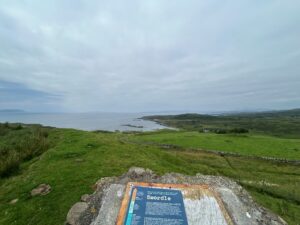
A view down onto Swordle Bay, with the Real Wild West information board
Henshall’s visit to Cladh Aindreis is noted in the record of the site as 19th October 1962. It is my starting place in Ardnamurchan as it was hers and although I am here in late July, you would not know it from the rain. I have seen the plan and read her description of the site but being on the ground is a different experience. Henshall’s plan gives a sense of the scale of the site, how small these surviving stones are in comparison to the full extent of the monument and her description provides a picture of the site within its landscape, the setting of the monument on rough grazing between the burn at hillside. Now I am stood here though, I can’t stop looking out to sea and wonder at its absence from her description. Over 60 years later, Henshall’s work still underpins how we understand this monument, not just from the measurements, drawings or descriptions, but from the huge body of work produced by Henshall that provides the context for the site. This record is the reason for not only my visit to Ardnamurchan, but for Phil and Hannah’s initial interest in the site almost 20 years ago, the catalyst for what became the ATP project.
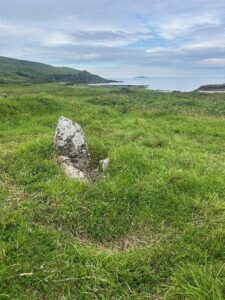
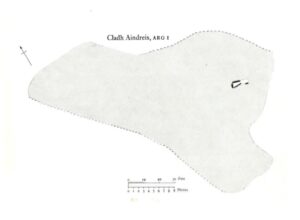
Two views of Cladh Aindreis. Above: Photograph of the chamber facing northwest (Eleanor Harrison). Below: A plan of the site (from Henshall 1972, 317)
I hadn’t appreciated my first view of Swordle Bay as I was distracted by the road but now walking down towards the beach I am stunned. As much as it felt like a journey to an impossibly remote place, here feels like the centre of the world. From the bay you can see out to the small isles of Rum, Muck and Eigg. Within my first evening I have seen deer on the hills, bats fluttering between the barns and even the fins of two minke whales out at sea. There is also a huge welcome from the people here, a community that has built up over the years of the project, with old faces and new coming back each summer. It is hard not to feel part of something exciting, and to start to feel connected to the people and the place. All in all, this seems like the perfect place to begin to explore the legacy of Audrey Henshall. Her presence here isn’t a loud one, but it is central to the history of the project and to what keeps bringing people to this place. I’m keen to learn more and the anticipation outweighs exhaustion as we watch the sun set over Ardnamurchan.
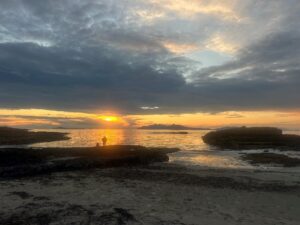
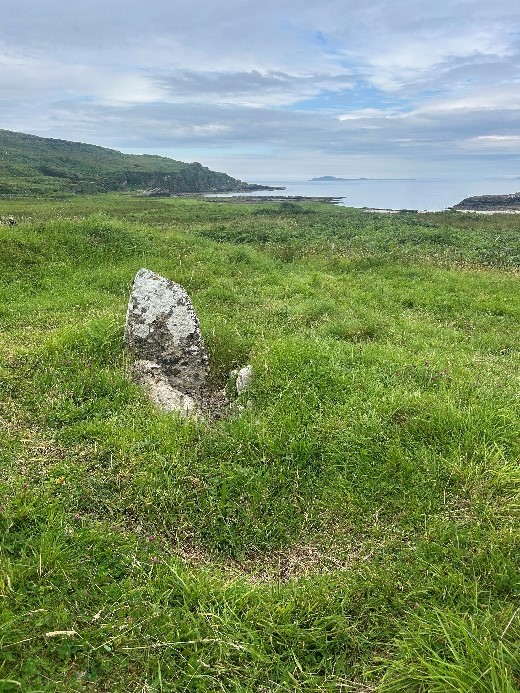
A view out to sea from Swordle Bay
To find out more about Audrey Henshall and her work, see our previous blog post here: Let’s Get to Know: Audrey Henshall | Archaeology Scotland.
Keep an eye out for the next in our blog series where I will be chatting to Professor Hannah Cobb, co-director of the Ardnamurchan Transitions Project about Audrey Henshall, Cladh Aindreis and archaeological legacies.